Tuesday, 16 October 2012

Friar's rice.

This week in Game Design, we had to make modifications to a game that goes by the title of Lair's Dice. This is a game that uses a bunch of dice as lives/betting tools (it feels like a weird mix of poker and Yahtzee to me) and whomever has at least one or more dice at the end is the victor. This is accomplished by guessing how many of a certain number is face up on ALL dice - including the ones your opponent is hiding. When a player makes a call, the next call must be higher then the previous one in terms of quantity, e.g. if Player 1 guesses there are two threes face up, then (should the next player wish to disagree with that statement) the next player must make a call of more - something like four fives, for example. All of this will be re-explained below in the rule excerpt from our game.

This time, however, we weren't tasked with creating a new game. As stated above, all we had to do was create one rule that broke what we call the "positive feedback loop." A positive feedback loop is something that the game gives to players who win. For example, when a you successfully win a hand by either bluffing or outwitting your opponent, you make them lose a dice. This is positive feedback for you and the game "loops" itself by playing the next hand. So, I created a rule that disrupts this loop on purpose - something that I don't believe is usually done, but that was the challenge, so that's what I tried to do.

It took me a while to wrap my head around the idea of abusing a player on purpose for doing well in a game, especially one which used card/dice elements (I say cards, cause that's sort of what I think of the dice as... I dunno, the poker thing again). Eventually, I came up with the idea of making the winning player unable to look at their hand on the next turn; essentially hindering someone who may have done a commendable job and breaking that positive feedback loop. To keep it from getting broken, however I included the fact that it could only be used once.

We were also asked how we thought this would affect our game loop before we even played.
The game will most likely be played out the same way, with players neglecting how much the blinding will affect them in the long run. I imagine the best use for this particular rule is when someone is on the verge of losing (e.g. on their last life/die). I say that because that's how I would use the rule - let a player with only one dice left win and then blind them the next turn, making it nearly impossible for them to guess.

When we actually implemented it and tried it out, things went different then expected. Turns out this tool can be a deal breaker, provided the player keeps it until striking someone out. Some people blindly throw it out as a counter to others moves – as well as using it for revenge. 

I'm thankful I didn't have to really create anything this time, with midterms coming up, I needed the chance to catch up on studying. Video games. Cause, y'know, that's what I do.

I am play these.
Above image taken from http://www.trmk.org/forums/showthread.php/25292-Fallout-%281-2-3-and-New-Vegas%29/page5.

Liar's Dice
Above image taken from http://www.everythingevergreen.com/liars-dice.html
In the rules below, you'll also see the rules that my team has included, as well as the rules for regular Liar's Dice.

RULES: 
----------------------------------------------------------------------------------------------------------------------------

The game is made for 2 or more players.  Suggested ages 12+


Each player has a cup and 5 dice (the cup can easily be replaced by using your hands). Players will roll the dice in the cups and hide what they rolled from the other players. The first player will make a guess about how many of a die facing there are. i.e. 3 fours or 2 fives.


The next player will have 3 decisions to make:
LYING: They can call their bluff by saying they are lying meaning there are less of the number that they guessed then there are between the players. i.e. if they say 4 twos and there are 3 or less between all the players then they are lying. If they are wrong and there are more or equal to the number they guessed they lose a die. i.e. if there are 6 twos.
CORRECT: The player can instead decide that the player is spot on meaning if there are exactly the number they guessed then every other player loses a die. i.e. if they said 4 twos and there are exactly 4 twos between all players they are correct. If there are not exactly as many as they guessed then they lose a die instead.
GUESS: The player can make their own guess if they think the player is correct but not exactly correct. When they make their guess their number of faces must be higher than the previous guess. i.e. if the player before them guessed 3 sixes then they must guess 4 or more of any facing such as 4 fives.

After one of the players choose lying or correct then the players reveal their rolls and determine if the player is right or wrong in their accusation. After that is decided the players roll again and the game continues with the next person starting the round off. After all but one player loses all of their dice then the game ends with the person with dice being the winner.

Our rule changes:
Bobby Muir: Players start off with 5 life counters. When a player would normally lose a die they instead lose a life counter.

Divakar Dev: If a player correctly calls a bluff he cannot look at his hand for the next turn.


James Creavalle: If a player improperly calls a bluff, they lose a life point.
Cole Bonvarlez: Each player is given a penny.  At any time when it is their turn, they can choose to trade in their penny to make the leading player show their dice to the rest of the table.

Vincent Marchesano: Once per game, (after a player wins a round) you can make the winning player unable to look at their hand on the upcoming turn. This move can only be done once and is indicated by some form of coin counter (the recommended coin is a dime). After a player uses their dime, the move cannot be used again.
----------------------------------------------------------------------------------------------------------------------------


Tuesday, 9 October 2012

Some of that olllllldddddd schoooolllll.

In Game Design this week, we were tasked with transforming an old Atari game into a modern card game. Initially, we weren't really sure how to take a card game and transform it into a card game - it just didn't seem to work. How could you take something where almost everything is happening instantly and port it to card? It just wasn't adding up. After attempting and tossing aside the likes of Dig Dug, Centipede and Bezerk, we finally came up with a way to use Lunar Lander.

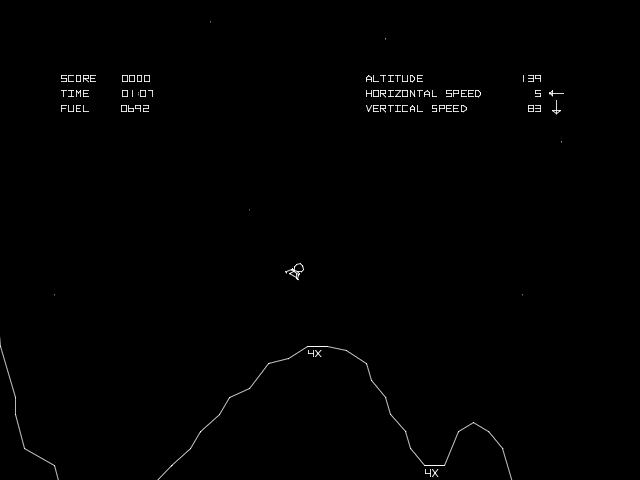
This guy right here.
Above image taken from http://upload.wikimedia.org/wikipedia/en/9/9f/Lunar_Lander.png.
The goal of Lunar Lander (the Atari game, not the card game) is to land your little lunar lander ship on one of the various "score multiplying landing zones" (on the Moon) while using the least amount of fuel possible - the less fuel you use to land, the more points you get (since the game multiplies your remaining fuel by the landing space multiplier). When play starts, you'll notice your ship slowly descend towards the surface due to the intense gravity of the Moon. To stay alive, you must then counteract gravity using the thrusters and try to land the lander. The player has three buttons for thrusters: clockwise (thrusting towards the left), counterclockwise (thrusting towards the right) and an "abort" button, which uses both thrusters at max for a short burst. The screen randomly populates different terrain and play ends once the player is out of fuel and crashes their lander. If a player runs out fuel mid-flight, the lander simply stops accepting any more user input and slowly plummets to its doom. When it comes to landing, the smaller and harder the landing, the bigger the multiplier. Points are awarded based on how evenly the ship lands and how hard the landing was. Players are also awarded a smaller bonus for crashing based on the severity of the crash (which is nice since this is probably one of the hardest games I've ever played), although some crashes can give you a fuel penalty.

 With the game all figured out and raging played a couple times, we then starting figuring out how to transform the game into a card game. Since the goal of the game was to land your ship while using the least amount of fuel, we decided to make this the core mechanic. But how to bring in diversity and competitive play...? To accommodate for this, we made each player build ships using different spaceship parts - with each part giving you a different amount of starting fuel based on the parts rank. We then incorporated the landing difficulties and multiplies by making each player pick up a Landing Difficulty card when they have build a ship they wish to launch - with harder landings transforming your fuel score into more points.

In this way, we anticipate that people who play the game will see exactly where it's coming from - there are landers to lune, fuel to try and use less of and points based on whether the landing was successful or not. Since it's also a race to get to a set amount of points, players are forced to decide when to launch their ship. Do they send the dinkier ship and risk crashing? Or do they wait for the best ship possible? If they wait, however, what if someone else is racking up points? All these things are factors that players will need to acknowledge and work around, when playing:

 LUNAR LANDER: LUNAR LANDINGS EDITION 
These are what the different cards look like. There's a Lander on each ship part, if you can see it.
Rules:
----------------------------------------------------------------------------------------------------------------------------
Players: 2-4 people


Set-up: Place the cards in two separate piles: one for Ship Parts and one for Landing Difficulty. Shuffle the decks and deal out 5 Ship Parts to each player. Each player may play one part at the count of three (e.g. Player 1 counts to three and on three, each player shows their card). Players then decide who will play first in whichever fashion they wish.

Instructions: Players try to build ships to collect ore off of the Moon while using the least amount of fuel. This is done by completing a whole ship (Hull, Thruster, Docking System, Landing Gear). Each part generates a different amount of fuel, with higher ranked cards generating more. Each player picks up a ship part card at the beginning of their turn OR starts a trade with another player. When trading, the trader (person initiating the trade) shows the card they wish to trade. Any player may then call for the trade, with who says they want it first getting it. Players may trade as many parts as they want for the offered part. The trade may also be cancelled at any point, provided the trader hasn’t already accepted the deal. If the trade is made, that player’s turn is done. If no one takes the trade, then play resumes as normal. They may then play one card from their hand towards their ship. There is no max to the number of cards a player may hold.

Once a ship is built, the ship goes into pre-launch mode, meaning that the ship can only launch on any turn after it is built. Players may continue to modify their ship at this point, but doing so delays launching the ship for another turn. When a player wishes to launch, they must pick up a Landing Difficulty card. The Landing Difficulty card multiplies your fuel into points, which are only tallied if the player lands successfully. Players land successfully if their total fuel amount for the ship is more than the amount on the Landing Difficulty card. Harder landings require more fuel, e.g. landing for a 4x costs 200 or more while landing for a 2x costs 100 or more. Players calculate their fuel cost by adding all the points on each of their ship parts. The different fuel gained by each ship part is as follows:
  • Rank A: 80    
  • Rank B: 70
  • Rank C: 60
  • Rank D: 50 
If a player lands successfully, they then subtract the total for landing from their fuel cost. They then multiply that remainder by the respective multiplier on the Landing Difficulty card and tally their points, e.g. if Player 2 has a fuel cost of 300 and the landing costs 200 for a 5x multiplier, Player 2 gets 500 points (100 times 5). If a player does not have the necessary amount of fuel points, then the player only gets 10% of their fuel amount, e.g. if Player 3 has 200 points and his landing costs 300, Player 3 gets 20 points. After a landing (whether successful or a crash) the player returns all the cards used for the ship to the Ship Parts pile. The player then tallies their points. The Landing Difficulty cards cost as follows:
  •  5x =300
  • 4x = 200
  • 3x = 150
  • 2x =100
  • 1x = 50
The first player to 2000 points wins.


----------------------------------------------------------------------------------------------------------------------------

I really enjoyed making this game and I feel as though the essence of the was captured. By creating almost no player interaction, the game boils down to the best landings possible and beating your opponent to the point total. This is what I feel the original one was all about - taking your time to get the best landing possible (in the best score zone possible) while conserving fuel. Allowing for trading also incorporates strategy against other players - do I try to give up my best ship piece for more lower ranked ones? This adds an element of excitement to the game while still keeping it close to the original and not changing the game too much.

One thing that would've been neat to see is some sort of fuel gain system. In the arcade version of the game (I'm not sure about the Atari version), players could add more quarters to gain fuel instantly. This would have been neat to have, although I'm not sure exactly how we would've put it in. It's possible we could have created some kind of part sacrificing/scraping device that would give you bonus fuel for a launch, but it seemed shaky and we didn't want to deviate too far from the Atari version of the game.

Overall, Lunar Landers: Lunar Landing Edition turned out very nicely - in my eyes, I'm basically playing Atari. While playing cards.