Showing posts with label Card Game. Show all posts

Tuesday, 27 November 2012

This game is: Automatic, Supersonic, Hypnotic...

Local produce has always had to compete with the "Big Guys" when it comes to selling their products; although its usually cheaper and better for the environment! This week, we were asked to create some kind of game that focuses on local Ontario fruits and vegetables - specifically when they're fresh/in season. The goal of playing our game is to give people within Ontario a heightened knowledge of when they can buy fruits and vegetables locally.

They'll be even fresher than these.
Above image taken from http://amengelkoch.blogspot.ca/
The first thing we had to do before we started was decide what kind of game we wanted it to be. We played around with the idea of the four seasons on a square, with each quarter of the square representing a different season. Since it couldn't be a race-to-the-end game and we're such a fan of cards, we then tried to incorporate them somehow. Since fruits and vegetables are only fresh during certain seasons, we created decks of cards based on the four seasons. We then searched online for the Ontario's government website which shows a list of when all of Ontario's fruits and veges are in season.

The game then took a turn here, when one of the group members decided that players should be collecting the fruits/vegetables based on the current season in an attempt to collect more fruits/vegetables than other players. This then evolved into players gaining money based on the type of fruit/vegetable they collected, with all-year one's generating less money than specific seasonal ones. We also gave player's the option to trade their fruits/vegetables with each other (specifically for getting one of the various bonuses that happen end-game) or purchase a Farm. If a player owns a Farm that makes the fruit/vegetable another player has drawn, then that player gets half of what the other player would have received. A few more specific details and tweaks later, and the game was finally complete.

RULES:
----------------------------------------------------------------------------------------------------------------------------


Players: 4 or more

Dominate the market in this all-out battle for farm produce domination! Compete to win the most money by growing and selling a variety of fruits and vegetables - or even trading for what you think could be the produce that rockets you to the top!

Set-up:

  • Each Season Deck must be shuffled separately and placed next to their respective Season on the board.
  • Each player receives $25 (each money piece is worth $5).
  • The spinner is then set to “Spring.”
  • Players can decide who goes first however they please.

Play:
  • At the start of a players turn, the player has the option to purchase a Farm Card by flipping over a Farm Card – your first purchase costs $10 and each subsequent purchase costs $5 more (2nd is $15, 3rd is $20, etc.)
  • Players may also trade any Farm or Produce cards with other players before beginning their turn.
  • The player then flips over a card from the current Season.
  • The player collects the money the card states – the rarer the card, the more money its worth. PLAYERS KEEP THE PRODUCE CARDS.
  • If another player has a Farm that produces the turned over card, the player who flipped the card must pay the Farm owner half of what they would’ve received.
  • After one whole round (e.g., when the first player begins their next turn), the Season changes to the next one in a clock-wise fashion.
  • After all four seasons have been played through, a new year begins.
  • Play ends after the end of the 5th year.
  • Players tally up all their Produce Card values and whoever has the highest value wins.
  • Players must also consider the End-Game Bonuses before confirming who wins:
o   Most Vegetables: $20
o   Most Fruit: $20
o   Rock a P (2 Peaches, Pears and Plums): $25
o   Garden Salad (1 Lettuce, 1 Carrot, 1 Cucumber, 1 Onion, 1 Mushroom and 1 Tomato): $35
----------------------------------------------------------------------------------------------------------------------------

The Season Tree game board.
In the end, this game became more fun than I thought it would - especially given the context of the idea. In my opinion, no one in their right mind would play a game that teaches you about when fruits and veges are in season; but I feel that the way we've structured our game keeps it hidden enough that the player doesn't necessarily know they're learning along the way. The game has a sort of Monopoly meets Mario Party vibe when it gets down to it; although one thing that player's seem to overlook is trading. This could be due to the fact that everyone is trying to get the same end game bonuses - so some form of card deck that contains random bonuses may have worked out better. The best possible thing (assuming we used a card deck) would be to shuffle the deck and select three bonus cards after the game is done. In this way, players are more likely to trade since they are unaware of what they'll need to collect a bonus when the game is over.

Thursday, 22 November 2012

Chikka changa changa.

Bollywood - an Indian style of dance that is slowly becoming increasingly popular in the western side of the world. One famous Bollywood film that has generated an unforgettable (literally lodged-in-your-head unforgettable) song is Dil Se with the cult favourite Chaiyya Chaiyya. The song features a large group of people dancing and singing on a train and being able to dance on top without falling off; impressive stuff.

See? Impressive. Who even knows how fast that train's going?!
For our game this week, we were asked to capture the essence of this particular Bollywood scene and transform it into a party board game that inspires movement - like games such as Twister. We decided that the best thing to do would be to get the players dancing - cause hey, that's about the only thing going on in this scene (next to the singing). We decided that players would draw cards and then watch a video to learn the move, with a limited number of views. Players would then perform the move and some point to get points, with harder moves earning more points.

We studied the Chaiyya Chaiyya clip, Jai Ho from Slum Dog Millionaire and the other Youtube "sensation" Tunak Tunak Tun. Using all these moves as the base, we then recorded ourselves performing the moves and proceeded to name them accordingly. Thankfully, I have 15 years of training in dance, so this really was a snap. The reason we chose these three songs is that we felt they captured the Bollywood essence best - all are upbeat and leave you with a carefree feeling. The moves themselves seem rather... impromtu, although everyone can be seen performing them at once. Its this carefree, semi-spastic flowing of the limbs that makes Bollywood what it is.

RULES:
-------------------------------------------------------------------------------------------------------------------------
Chaiyya Chaiyya Party Extreme!

Setup:


  • To begin a new game of Chaiyya Chaiyya Party Extreme, both the Easy Dance Deck and the Hard Dance Deck must be shuffled separate from each other.
  • From here, the easy deck and the hard deck are placed on the game board inside their designated areas.
  • Determining which player goes first is simple.  The owner of the game goes first and then determines the order for the game.
Gameplay:
  •  The Gameplay phase begins when the first player picks up either an Easy or Hard Dance Card.
  •  After choosing their card, the player will read off the card details to the other players of the game.
  • On each card are three details: The Song Indicator, The Dance Move, and the Score Modifier.
  • After the details have been revealed to the other players, the dancing player must find their corresponding dance move in the dance list.
  • The player will be able to view the dance move twice before they are allowed their one chance to complete three consecutive repetitions of the move.  Dancing will be completed with the three songs provided.
  • The other players will judge whether the player has completed their move successfully
  • If the move was completed, the player gets the corresponding score and they keep the performed dance card in their hand. If the move was not completed, the card is inserted back in the deck
  • Each player may only have a maximum of four cards in their hand at one time. The player may pick up a Dance Card and perform for their score however, they must discard before a new card can be added to their hand
  • Whenever a player has more than one card in their hand, they may attempt a Combo Dance!  This means that the player may try and perform all of their dances in one performance to earn all of the score modifiers combined! 
  • To win, a player must reach a score of 1000 points, or a player can win through the Special Combo Dance.  A Special Combo Dance is when the players four cards are all from the same Song Indicator.  If the is able to complete the Special Combo Dance for the duration of the songs provided!
  • HAVE FUN!
 -------------------------------------------------------------------------------------------------------------------------

Overall, it was a pretty interesting experience creating a dance game. One thing I wish we could have done was create an interactive DVD video of sorts with a cool menu. This would've made the experience way easier to convey to the user. Also, it would be cool if there was a sort of training mode where the moves are walked through slower in case people wish to practice.

None the less, this game will get you hopping and laughing at your friends - guaranteed.


Wednesday, 31 October 2012

Tic toc, Batman; tic toc (toe?).

Ahh, Tic-Tac-Toe. My friend; my enemy. The times and places I've played you while waiting for important things to happen is so vast... Jack Astors', on a napkin, with my brother... Good times; good times, indeed.
                - Me, the blogger

This week we were tasked with doing a little -chikka chikka- REMIXING. We were asked to remix two games: Tic-Tac-Toe and a game we had created previously. As I'm sure we all know, Tic-Tac-Toe is played by one person assuming the role of X's and the other O's. Players play on a 4x4 grid and take turns placing their respective symbol on one of the spots. The first person to get three in a row in any direction (including diagonal) wins. If neither player achieves this, it is a tie. Our objective was to add another rule to this game and make it challenging/fun for players of all ages while adding some form of random element. I quickly came up with a concept - some sort of tile rearranging system that dictates who can place their symbol down. This could be done with either two players or four players, although the four player board would need a bigger matrix of play.

2 player board.

4 player board
But a name was still needed: TicXTax. Perfect. To add the random element, I then included a deck of cards. There are two types of cards: Board cards and Player cards. Each Board card has a number and a sub-number. The deck is shuffled and then cards are played face down on the board. Each player then draws three cards. If a player has a card with a matching combo and sub-combo for any combo on the board, then the player pay put their card there. (e.g. if Player 1 has a 3-1 card and Player 2 has a 3-4 card and there is a 3(1-5-4), then both players may use that space). If a player is unable to go, then they pick up a card. The first player to three in a row wins. On the 4 player board, the first to 5 in a row wins.

Board cards.

Player cards.
RULES:
----------------------------------------------------------------------------------------------------------------------------

Set-up:
  • Shuffle both the decks of cards. Place the board cards one-by-one onto the board, turning each face-up as you do.
  • Each player then draw's three cards.
 Play:
  •  Players take turns placing matching cards on the board. The first to 3 cards in a row wins. If neither player succeeds, its a tie.
----------------------------------------------------------------------------------------------------------------------------

After playing the game a couple times, I found that the game become more tolerable than regular Tic-Tac-Toe (I lied, its not that fun. When its come down to Tic-Tac-Toe, save yourself). The only problem was when it came down to neither of us being able to draw a card that we needed to play to win; the card would either already be played elsewhere or just at the bottom of the deck. Regardless, this is a nuisance that helps keep that "random" element of the game.

 After finishing that hot track, I started working on the next. I decided to remix the game H.A.C.K.E.R.S., created by myself, James Creavalle and Divakar Dev (see my blog post about it here.)

In H.A.C.K.E.R.S., each player tries to over take the others by collecting power bits and overtaking other player's nodes. The random element of the game that I've added is a random number generator from 1-9 or a spinner. This spinner would replace the flat rate of acquiring bits that players used to get each turn. Players would collect their respective role and then continue play as normal.

RULES:
----------------------------------------------------------------------------------------------------------------------------

Set-up: Each player chooses a Faction to represent in the war by choosing a colour of bead. Factions then roll to see who goes first or play Rock, Paper, Scissors. Players chose a starting node based on turn order. Each node is assigned 10 bits of power. Players then decide how many turns the game will run for. At the end of the last turn, the player with the most nodes wins.

Play: Each node runs on bits. Players accumulate bits at the beginning of each turn by either spinning a spinner or using a random number generator from 1-10. Players amass bits based on what they roll with a boost based on how many nodes they own, according to the following chart:
  • ·         3 nodes = +2
  • ·         6 nodes = +4
  • ·         9 nodes = +5
  • ·         12 nodes = +7
After capturing 12 nodes, you gain +1 for every 2 more captured nodes. The collected bits are then distributed to each node based on the players choosing. Nodes are indicated by placing the small blue beads on the node you control.
There are 3 phases per turn: Transfer, Boost and Hack. During the Transfer phase, players can transfer power to any nodes that they are connected to. When a bit is sent, it is subtracted from the current total as well, (e.g. if node A has 12 bits and sends 4, node A will have 8 bits after). Players may only transfer bits once per turn. Nodes can only hold 30 bits max. 
In the Boost phase, players may sacrifice bits to set up Firewalls. Firewalls make you harder to hack during the Hacking phase and disappear on your next turn. To indicate a Firewall has been placed, select a bead colour for “Firewalls” and place it on your node. Firewalls are powered up based on the following:
  • ·         Firewall Lvl 1 (costs 5 bits): reflects 2 bits of damage
  • ·         Firewall Lvl 2 (costs 7 bits): reflects 3 bits of damage
  • ·         Firewall Lvl 3 (costs 9 bits): reflects 4 bits of damage
  • ·         Firewall Lvl 4 (costs 12 bits): reflects 5 bits of damage
During the Hacking phase, players may sacrifice bits to attack other players. When sacrificing, players must leave at least 10 bits in the node to sustain their capture of it. Players may only attack once. To attack, players select any node they are connected to. Players may then attack that node with any other nodes they own that are connected to it. The defender then decides how many bits to use to defend. If the defender uses more bits than the attacker, the difference is dealt in damage to the attacker; e.g. if the attacker sends out 10 and the defender defends with 15, the attacker loses 5 bits on their node(s).
---------------------------------------------------------------------------------------------------------------------------- 
 The game played basically the same with the now added annoyance of gaining less when you may have needed a higher roll to survive. Again, this (although maybe not the greatest addition) still remixes the game while keeping the random element in place.  

Tuesday, 9 October 2012

Some of that olllllldddddd schoooolllll.

In Game Design this week, we were tasked with transforming an old Atari game into a modern card game. Initially, we weren't really sure how to take a card game and transform it into a card game - it just didn't seem to work. How could you take something where almost everything is happening instantly and port it to card? It just wasn't adding up. After attempting and tossing aside the likes of Dig Dug, Centipede and Bezerk, we finally came up with a way to use Lunar Lander.

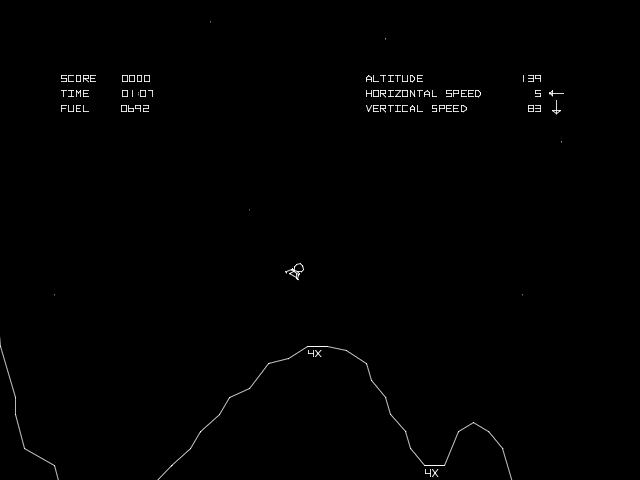
This guy right here.
Above image taken from http://upload.wikimedia.org/wikipedia/en/9/9f/Lunar_Lander.png.
The goal of Lunar Lander (the Atari game, not the card game) is to land your little lunar lander ship on one of the various "score multiplying landing zones" (on the Moon) while using the least amount of fuel possible - the less fuel you use to land, the more points you get (since the game multiplies your remaining fuel by the landing space multiplier). When play starts, you'll notice your ship slowly descend towards the surface due to the intense gravity of the Moon. To stay alive, you must then counteract gravity using the thrusters and try to land the lander. The player has three buttons for thrusters: clockwise (thrusting towards the left), counterclockwise (thrusting towards the right) and an "abort" button, which uses both thrusters at max for a short burst. The screen randomly populates different terrain and play ends once the player is out of fuel and crashes their lander. If a player runs out fuel mid-flight, the lander simply stops accepting any more user input and slowly plummets to its doom. When it comes to landing, the smaller and harder the landing, the bigger the multiplier. Points are awarded based on how evenly the ship lands and how hard the landing was. Players are also awarded a smaller bonus for crashing based on the severity of the crash (which is nice since this is probably one of the hardest games I've ever played), although some crashes can give you a fuel penalty.

 With the game all figured out and raging played a couple times, we then starting figuring out how to transform the game into a card game. Since the goal of the game was to land your ship while using the least amount of fuel, we decided to make this the core mechanic. But how to bring in diversity and competitive play...? To accommodate for this, we made each player build ships using different spaceship parts - with each part giving you a different amount of starting fuel based on the parts rank. We then incorporated the landing difficulties and multiplies by making each player pick up a Landing Difficulty card when they have build a ship they wish to launch - with harder landings transforming your fuel score into more points.

In this way, we anticipate that people who play the game will see exactly where it's coming from - there are landers to lune, fuel to try and use less of and points based on whether the landing was successful or not. Since it's also a race to get to a set amount of points, players are forced to decide when to launch their ship. Do they send the dinkier ship and risk crashing? Or do they wait for the best ship possible? If they wait, however, what if someone else is racking up points? All these things are factors that players will need to acknowledge and work around, when playing:

 LUNAR LANDER: LUNAR LANDINGS EDITION 
These are what the different cards look like. There's a Lander on each ship part, if you can see it.
Rules:
----------------------------------------------------------------------------------------------------------------------------
Players: 2-4 people


Set-up: Place the cards in two separate piles: one for Ship Parts and one for Landing Difficulty. Shuffle the decks and deal out 5 Ship Parts to each player. Each player may play one part at the count of three (e.g. Player 1 counts to three and on three, each player shows their card). Players then decide who will play first in whichever fashion they wish.

Instructions: Players try to build ships to collect ore off of the Moon while using the least amount of fuel. This is done by completing a whole ship (Hull, Thruster, Docking System, Landing Gear). Each part generates a different amount of fuel, with higher ranked cards generating more. Each player picks up a ship part card at the beginning of their turn OR starts a trade with another player. When trading, the trader (person initiating the trade) shows the card they wish to trade. Any player may then call for the trade, with who says they want it first getting it. Players may trade as many parts as they want for the offered part. The trade may also be cancelled at any point, provided the trader hasn’t already accepted the deal. If the trade is made, that player’s turn is done. If no one takes the trade, then play resumes as normal. They may then play one card from their hand towards their ship. There is no max to the number of cards a player may hold.

Once a ship is built, the ship goes into pre-launch mode, meaning that the ship can only launch on any turn after it is built. Players may continue to modify their ship at this point, but doing so delays launching the ship for another turn. When a player wishes to launch, they must pick up a Landing Difficulty card. The Landing Difficulty card multiplies your fuel into points, which are only tallied if the player lands successfully. Players land successfully if their total fuel amount for the ship is more than the amount on the Landing Difficulty card. Harder landings require more fuel, e.g. landing for a 4x costs 200 or more while landing for a 2x costs 100 or more. Players calculate their fuel cost by adding all the points on each of their ship parts. The different fuel gained by each ship part is as follows:
  • Rank A: 80    
  • Rank B: 70
  • Rank C: 60
  • Rank D: 50 
If a player lands successfully, they then subtract the total for landing from their fuel cost. They then multiply that remainder by the respective multiplier on the Landing Difficulty card and tally their points, e.g. if Player 2 has a fuel cost of 300 and the landing costs 200 for a 5x multiplier, Player 2 gets 500 points (100 times 5). If a player does not have the necessary amount of fuel points, then the player only gets 10% of their fuel amount, e.g. if Player 3 has 200 points and his landing costs 300, Player 3 gets 20 points. After a landing (whether successful or a crash) the player returns all the cards used for the ship to the Ship Parts pile. The player then tallies their points. The Landing Difficulty cards cost as follows:
  •  5x =300
  • 4x = 200
  • 3x = 150
  • 2x =100
  • 1x = 50
The first player to 2000 points wins.


----------------------------------------------------------------------------------------------------------------------------

I really enjoyed making this game and I feel as though the essence of the was captured. By creating almost no player interaction, the game boils down to the best landings possible and beating your opponent to the point total. This is what I feel the original one was all about - taking your time to get the best landing possible (in the best score zone possible) while conserving fuel. Allowing for trading also incorporates strategy against other players - do I try to give up my best ship piece for more lower ranked ones? This adds an element of excitement to the game while still keeping it close to the original and not changing the game too much.

One thing that would've been neat to see is some sort of fuel gain system. In the arcade version of the game (I'm not sure about the Atari version), players could add more quarters to gain fuel instantly. This would have been neat to have, although I'm not sure exactly how we would've put it in. It's possible we could have created some kind of part sacrificing/scraping device that would give you bonus fuel for a launch, but it seemed shaky and we didn't want to deviate too far from the Atari version of the game.

Overall, Lunar Landers: Lunar Landing Edition turned out very nicely - in my eyes, I'm basically playing Atari. While playing cards.