Tuesday, 3 December 2013

PvPortal2 2

Today, I played my good friend Bobby Muir's Portal 2 level.  This blog will be about my experience with this level and an assessment of the design and design choices he made, along with how I feel it could be improved/modified. Here we go:


When I first entered the room, I was greeted by a switch and a laser grid. I ran up to the switch to see that it was a square switch, meaning I needed to go look for the cube to place in it.


A quick survey of the room showed that there was an area I could portal up to. There was a dropper up there, so it was fair to assume that this would be the cube dispenser.


Which it was. Running through led to a button switch and a pressy switch (as I like to call them). Since there was a laser grid, I had no choice but to press the pressy one.


This flipped a wall panel. I looked around to see if there was anywhere else to go... but there was no clear "this way." I then realized that the switch was also a square switch, so i created a portal on the newly flipped wall and ran back to grab my other cube. I placed it on the new switch and removed the second laser gate.


There was another pressy switch behind the gate, so I went ahead and pressed it. 


I noticed that it flipped over a panel on the ceiling. Now it was a race against time, since I had to run back to the first pressy switch and open the wall in front of it. This would allow me to complete the portal to the new area up top.


Yay, I'm probably done now - oh. Some stairs. Alright, let's see where this goes.


So I ran into a cube and yet another infamous pressy switch. Hoping that the switch would turn on the polar beam, I went and placed it in. Pressing the switch instead, opened up a flip panel. 


There was another set of these and I climbed up. Across from me, I saw there was a switch, so I fell back down and brought the ball up with me.


Once I portaled over and placed the ball in, the polar beam turned on. I rode it up to the next ledge.


And yet, we were not through yet.


I walked through to find a light bridge and some lovely death goo all over the floor. Falling here would mean restarting - and no one wants to do that. I opened up a bridge using the available walls and I dropped down.


I followed the bridge to the end and turned to see another area.


I shot the orange portal  and jumped so the light bridge would stay underneath me. I walked across and found a way to bypass most of the area: I just jumped and shot the orange portal allowing me to slowly ascend.


I turned the corridor to find I wasn't done the level yet. I used the blue gel to jump up and...


Find mo' level. I walked around to do a complete survey of the new area before assessing what my next step should be.


Well, looks like I gotta diffract some lazors. I placed the cube down in front of the laser and then went and opened a portal.


I ran to the other side and used the first cube to diffract the laser into the orange portal, shoot out the blue one, hit the second cube and shoot into the laser relay. It worked perfectly, and my reward was some stairs.


Climbing the stairs led me to the worst thing I have ever experienced. This cube was blocked by a switch... that respawned the cube. Sphere. Whatever. It was the worst.


This. THIS. THIS.


Ahem. After finally getting around it, I dropped the cube down to get another wall flip.


I portaled up to see that there was more to do on the top. There was a switch that made a wall flip and a light bridge appear - so I did the obvious.


After running across, I was greeted by this last thing - which is always fun to do.


Weeeeeeeeeeeeeeeeeeeeeeeeeeeeeeeeeeeeeeeeeeeeeeeeeee.

All in all, the design was very nice. Some areas felt a tad spacious and could have used a little bit of tightening, but I enjoyed how certain elements compounded on each other - like in the first area, for example. The single point progression was really awesome and each piece fit together very nicely. The light bridge area could have used a little extra oomph (the one with the goo) since it felt like I was merely wandering instead of exploring.

AND THAT GOD DAMN SPHERE BUTTON. A great troll, but it was still so... painful. The worst was how the ball could trigger the switch, so even if I got over successfully, it could suicide. That's actually what it was - sphere suicide.

I really enjoyed the diffraction puzzle, but that could be simply due to me really enjoying puzzle games and puzzles with lasers. It felt neat to line it all up and have it happen in one shot - and after talking with Bobby, he said I did it differently than intended, but it was still pretty cool.

That's what I give this level. Cool/5, would play.

Monday, 2 December 2013

Dekonstru Number Two

For today's game atom analysis, I will be assessing Super Mario Bros. 2 (the weird one that is a Mario-ified reboot of this game). A bizarre turn of events in the Mario series in terms of design, this was still a very enjoyable game in which you can pull veggies out of the ground and throw potions that spawn doors. As the game was released several times in terms of reboots for graphics and bug fixes, I will be reviewing the original version of the game. Now let's dive in and see what this game is all about.


Players:

Oddly enough, this version of Mario was singe-player only. (The reboots received multi-player). There is no other in-game interaction with other players. However, considering the time of release, its fair to assume that people may have played with friends.

Objectives and Goals:

The primary objective of SMB2 is to defeat Wart (the final boss) and free Subcon. The secondary objective would be to get to the end of each level and get swallowed by an eagle-crow, in turn progressing to the next level.

Resources:

There are quite a few resources in SMB2:

  • Hearts
  • Bushes
    • Veggies
    • 1-Ups
    • Timer
    • Hidden flasks
      • Coins
      • Heart containers/Mushrooms
  • Cherries
    • Starman
  • POW Blocks
  • Mushrom Blocks
  • Bombs
  • Eggs
  • Glass Orb
The secondary categories means that the resources are linked - for example, every 5 cherries collected makes a Starman appear on screen. The worst part about that is that it is almost a negative feed back loop since you aren't guaranteed the Starman - you just get to have one appear onscreen. Hearts appear after killing at least three enemies on screen - this is accomplished by either throwing a veggie and chain hitting 3 enemies or dropping a POW block (which kills every enemy on-screen). 


Veggies are acquired by plucking these little grass patches that are scattered throughout the level. What's underneath the bush is the same every time you play, so you can memorize what is underneath to ensure you always get it. 1-Ups give you an extra life and the Timer freezes all enemies for a set period of time. Hidden flasks are really neat - they create a door to the "Sub-space" wherever the collide with the ground. Players can go through this door to find special items that only exist in the Sub-space, such as Coins and Mushrooms/Heart containers (which add an extra Heart to your life meter).

Bombs can be thrown to blow up brick blocks. The bomb changes colour to indicate how close it is to exploding, before exploding and damaging anything that connects with its "bomb" explosion. Eggs are a special case since they are only used in Birdo fights, which happen at the end of some levels. The player needs to jump on the egg that a Birdo spits out and throw them back at her to inflict damage. Defeating Birdo creates a Glass Orb - collecting the Glass Orb opens the gate to the next level. (Note, not every level has Birdo at the end... sometimes the Orb is just sitting there).


Rules and Mechanics:

Regular World Rules
  1. The player can only select and play as one character at a time.
  2. Each character has 3 stats with varying 'strength' based on the character.
  3. Strength affects how quickly a character picks things up.
  4. Jump affects how high a character can jump.
  5. Speed affects how fast a character can run.
  6. When a player loses all health, they lose a life.
  7. If a player falls off of the screen, they lose a life.
  8. Losing all lives results in a game over.
  9. After beating a level, the player can change characters. (Death does not allow you to change characters)
  10. Players can pick up objects by pressing B.
  11. Players can throw objects they are holding on to by pressing B again.
  12. Players can jump with A.
  13. Players can hold B to run faster (up to a cap).
  14. Holding down builds a jump charge - pressing A after allows the player to jump higher.
  15. The camera scrolls horizontally with the player.
  16. Players must pass through the gate at the end to advance to the next level.
  17. Players can play a slot game at the end of each level, with 1-Ups as prizes. (Note: the player needs coins to play the game).
Sub-space Rules
  1. All grass patches turn in to coins when pulled.
  2. The player can only move in as much screen space there is (the screen won't scroll).
Regular World Mechanics
  1. Throwing a Hidden flask at the ground creates a door at that location.
  2. Every 5 Cherries collected (across one level) will make a Starman appear onscreen.
  3. Killing three or more enemies in succession (or at once) will generate a heart onscreen. (They must be killed with a single veggie, e.g. a "chain kill")
  4. Players can pick up most enemies.
  5. An enemy hit by a veggie/enemy will be killed.
  6. Grabbing the Glass Orb opens the gate to the next level.
Peach Mechanics
  1. Pressing A again in the air allows Peach to float for a set time (as long as A is held).
  2. Peach can only do one float per jump.
Luigi Mechanics
  1. Luigi is slipperier than the other characters (takes longer to change direction)
Information:

The information in this game is given by experience - you won't really know what works until you try. When first playing the game, it isn't clear whether or not you can pick up enemies; intrinsically you'll spend most of your time throwing the veggies before you realize you can stand on enemies and lift them up. Also, there is no way of knowing where a Mushroom is in the Sub-space unless you get the door right the first time. This is due to the fact that you can't get the screen to scroll in the Sub-space. While it isn't the best way of giving information, it makes sense for the time that the game was out (which we'll talk about at the end).

Sequencing:

The game happens in real-time, as a platformer should. I can't even conceive what a turn-based platformer, or any platformer with delayed input, would be like...

Player Interaction:

None, since this is a single-player game.

Theme/Setting:

Well, since Subcon is a dream world (subconscious... HILARIOUS!), the setting of the game is very apt. We're going through all these crazy worlds, fighting all these crazy bosses, pulling vegetables out of the ground... It all feels like it gels nicely.

How do these systems come together to work?

Better than one would expect, actually. While the whole, learn about it after getting it is one of the most unenjoyable ways to play a game, it makes sense for the time period. The easiest way to get you to keep playing the game is keep dying and looking for an answer. Need more health? You need to search for it. The worst part is that you only get one potion - that potion won't respawn after use. This means you need to hold it and run around the particular area you are in and HOPE you threw it down at the right spot. 

I really do enjoy that each character has different stats as well... if they were listed. I actually didn't even know about the stats until the GBA remake of the game. The stats are very real, though, and very crucial to how you play the game. The first time around, it makes sense to assume that the characters play 100% the same and are merely ascetically different. The only stat that really shines in showing there's a difference is the jump stat - and even then its still only blatantly obvious on Luigi. The strength aspect is fairly obvious with Toad, but it's a fair assumption that you might not even see the difference.

Do you see stats? Cause I don't.
None the less, the different characters is a really sweet addition to the game. My final qualm with this game is the spawning of the hearts and Starman. Getting these objects to appear doesn't guarantee that you will get them - it merely means they will show up on the screen and can be collected. There's nothing worse than having low health and watching a heart float out of your jump range. It really is just the worst.

Now that I'm done ripping on those things, let's not forget that this actually is an enjoyable game. It has tight controls and requires lots of focus to ensure victory. The tension moments are great too - picking up a key to have a crazy, floating head chase you down until you drop it is down right terrifying. The special alternate routes in some stages are also really cool - SMB2 is just a good platformer. While not the best in the series, it is definitely a nice taste of some new innovation.

3/5, would play.

Sunday, 1 December 2013

PVPortal2

Today, I played my good friend Divakar Dev's Portal 2 level. This blog will be about my experience with this level and an assessment of the design and design choices he made, along with how I feel it could be improved/modified. Here we go:


Upon entry, I'm greeting with a light bridge, some death goo, and an area off to the right. A quick sweep of my surroundings shows many black walls and a platform right in front of me. The light trail shows that the platform switch isn't around here,  but it looks like there's an area off to the right that I can get to.


After making a portal over to there, I notice there is some white wall behind me that I can use to portal jump over. Turns out there's a cube here and I reckon it will fit in the cube switch beneath me. 


Success! The platform on the other side is now mobile. I died after this attempt in the goo, but it did lead me to find an interesting work around for what I assume was intended. I ended up being able to create a light bridge right from the beginning to the area with the cube.


So, crossing the platform brings me to this switch. Upon pressing it, the fizzlers that were overhead near the beginning of the level vanish - giving me access to the white space that's up there. Logically, the only way to advance is to use the light bridge to cross my way over.


In this smaller area, there is a switch and some lasers that go along a longer hall. I didn't bother looking to see what was down there since there were lasers and death in player-created content sends you flying back to the beginning of the level. I gave the switch a press... and nothing happened.


 Following the light relay reveals that there were some hidden stairs down near the cube switch. There was a ticking noise as well, which means those stairs aren't going to last forever. I quickly jumped down and ran up the stairs to find yet another switch.


I gave it a press and followed the light trail to see that it was back up in the area with the switch I just pressed. I went back to the light bridge, but this time I aimed it slightly more right. This allowed me to travel down the small narrow passage. I found a room with more goo and more lasers for my enjoyment. I saw a moving platform as well, so I ran to the end of the bridge and dropped down.


I portaled through the giant laser grid (since there was white below me and on the wall over there) and found two laser relays on the walls - one hooked up to the door, the other hooked up to the laser wall. It was at this moment that I realized I wasn't supposed to be on the other end of the laser relay... I believe Div intended for you to use portals to grab the laser and revert it into the relay.


Anyway, now to figure out how to get this door open. I ended up using the portal method to bring the laser right next to the door. I then grabbed the reflector cube and kept it aimed at the relay while slowly inching towards the now open door.


Closer....


Closerrrr......


Success! The doors didn't close on me since I was already in front of them and I was able to bypass what I assume was the normal route. Further inspection revealed that I could have just created a portal across the goo and shot the laser directly into the wall. But what fun is that?

Overall, I thoroughly enjoyed playing this level. It wasn't too long and it had enough in there that it didn't feel repetitive. There could have been more placement of black tiles to prevent portalling into areas that he didn't want me in yet, or maybe even the use of a fizzler instead of a laser wall at the end part of the level. Actually, the ending might have benefited from a little more work - the reflector cube seemed kinda useless. While I enjoy that it was there simply because it diversifies the amount of ways you can complete the level, having that openness also obstructs from the use of it. If there was even a sort of maze section in which you needed to set up a reflector path or something could have been cool.

The progression of the level is really nice as well - I felt like I was truly earning the right to move on as opposed to hacking my way through. This feels the most solid at the point of the light bridge, where I get to bring it up and go across to the last area with all the goo. I also wish there was more fail safe on the part where you jump off the light bridge to land on the platform, but I realize that this is simply due to the fact that Portal 2 levels can't have save-points unless they are created in the editor and with Hammer.

Overall, this level gets a 4/5, would play.

Dekonsteur Numero Uno

With each generation of Pokemon, more and more complexity was injected into the design of the game. While most of it was seen on the surface (new Pokemon, new types, new moves, etc.) there was a lot of work going on in the background (Individual Values, Effort Values, how Pokemon were generated, etc.) As one of my all-time favourite handheld series, I'm going to take the time today to break down its game atoms (specifically those of Pokemon HeartGold and SoulSilver) and find out whether they synergize together.

Players

Pokemon is predominately a single player game that also allows for inter-player interaction that is both competitive and co-operative (depending on what it is you do with these other players). Since Pokemon is about collecting and battling, these are the main focal points of player interaction: you can fight your opponent in either 1v1 or 2v2 Pokemon fights (that's for the Pokemon, not the trainers) or trade with them to build your Pokemon collection. Heck, you can do both if you want. Players can also work together in areas like the Battle Frontier to try and take down NPC trainers in specific battles with certain rules.

Objectives and Goals


Holy crap, this one could be a while. I suppose the primary goal (the one the story gives you, anyway) of Pokemon HG/SS is to collect all 8 badges, defeat the Elite 4 in the Jhoto region, collect the other 8 badges in Kanto and then defeat Red, the Champion of the World. However, along the way, you can stop to do anything that your heart desires.  Maybe you want to collect every single Pokemon and complete your Pokedex? Or maybe you just want to breed Pokemon and make a team filled with the cream of the crop? Maybe you hate battling/breeding and just want to race your Pokemon in the Pokeathlon? While some of these can't be fully achieved until end game, there is really nothing else limiting the player from doing what he or she wants at any given time (within the boundaries of the game world).

Resources

In Pokemon, there are a two categories of resources:

  • Pokemon
    • Type
    • Nature
    • Abilities
    • Gender
    • Moves
    • Stats (Health, Attack, Defense, etc.)
    • IV (Individual values)
    • EV (Effort values)
  • Items
    • Held
    • Usable
    • Key
    • Berries
    • HM & TM
    • Pokedollars
These are, effectively, the main resources of the game. Everything about the Pokemon is generated once the battle is initiated or when the Poke-egg is received, save for Effort values (we'll cover this in a bit). There are limitations to this (e.g. you'll never find a Water-type Pidgey), but for the most part, each Pokemon can be found with one of two abilities and various IVs in each stat ranging from 0-31. These stats are invisible and are applied to the base stats of the Pokemon. The IVs determine how good a particular Pokemon is in that stat (e.g. a Geodude with a Def IV of 31 is better than one with an IV of 10).

Now here's where it gets tricky: Pokemon gain Effort Values by gaining EXP from other Pokemon. Every 4 EVs gained in a stat gives a +1 boost to said stat. These stat boosts aren't seen until the Pokemon gains a level, which can result in seeing some huge numbers on leveling. (e.g. defeating 2 Luxio's gives you 4 EVs in Attack, which gives an additional +1 when you level up). A Pokemon can have a maximum of 510 EVs across all stats, with a max of 255 per stat.

Now, outside of the whole Pokemon IV/EV thing, there are held items and various TMs and HMs you can give to your Pokemon. The TMs and HMs contain moves that you can teach your Pokemon - however, each Pokemon can only know four moves at a time. Pokemon gain moves through leveling, by being bred with a parent who knows the move, or the aforementioned. There's also items you can give to your Pokemon that do different things; for example, Leftovers heals your Pokemon for 1/16 their maximum health every turn. Focus Sash prevents a Pokemon from being killed if they have full HP and are hit with a move that would've other wise killed them.

Finally, we'll talk about Natures - these are also determined at the inception of the Pokemon. Natures give a +10% to one stat and a -10% to the other. There are also 4 neutral natures that do nothing, and they are sad, and make me feel sad when I get them.

Whew. Now then, quick recap in which we will fictitiously train a Rattata to domination. So, we catch our Rattata in the wild - this one's nature is Jolly (+Spe/-SpA) and it has flawless IVs (31 in every stat). WHAT ARE THE CHANCES?! So, we've got our Ratty, now we build his move-pool. We want him to end with Facade, Sucker Punch, Protect and U-Turn. Sucker Punch is the only one we need to learn via level-up, and that will happen at level 19. The rest of the moves are all TM based - so we simply give Rattata the TMs whenever we want. The EV spread we're going for is 36 HP / 228 Atk / 180 Spe. This means we need to defeat 36 Slowpoke's (1 HP EV per), 114 Seaking's (2 Atk EVs per) and 180 Magikarp's/Rattata's (1 Spe EV per). (I chose these Pokemon based on the fact we're referring to HG/SS, and as you see, trading them to another 4th Gen game is way better than doing it in this one). If Rattata was holding a Macho Brace, he would gain double the EVs per kill, shortening the process even further. There are also other items called the Power Items that speed this up even further, but we shan't discuss these today. Lastly, what item to give him? Well, since we gave him Facade, we'll give him a Toxic Orb to hold. At the end of the first turn a Pokemon enters the battle on, the Pokemon will be infected by heavy poison, if they hold the Toxic Ord. Facade's base power doubles when the user is afflicted by a status. Rattata's ability, Guts, increases Attack by 50% when the user is afflicted by a status as well. So as you can see, we now have a very beefy Rattata - he's squishy and won't last long due to poison, but he makes for a great late game sweeper.


Rules and Mechanics

Once again, with a game so varied, there are numerous rules and mechanics based on what exactly is happening, but there are constant rules that are pretty much applied across all instances.

Constant Rules:
  1. A player can only carry 6 Pokemon at a time.
  2. Pokemon can only use certain items on their own - all other items must be applied by the trainer.
  3. Once a Pokemon's HP hits 0, the Pokemon faints and is unusable (said Pokemon can still perform HM moves on the over-world).
  4. If all of a trainer's Pokemon faint, then the player whites out to the nearest Pokemon Center.
  5. Pokemon have strengths and weakness based on their types.
  6. Pokemon can only know four moves at a time.
  7. Each Pokemon can only learn certain moves.
  8. Pokemon cannot exceed Level 100.
  9. Defeating another Pokemon in the wild or in an NPC trainer battle gives any Pokemon who was out during the time of the opposing Pokemon EXP.
Over-world Rules:
  1. Walking into tall grass (or around in caves/surfing on the water) means you can randomly encounter wild Pokemon (which types are specific to the area/method of encounter).
  2. You can talk to any other 'person' you see in-game.
  3. If an opposing trainer looks in your direction, you will fight them.
Battling NPC Rules:
  1. You may use items in place of using a move.
  2. You can switch Pokemon instead of using a move.
  3. If you beat the opponent, you get their money. If you lose, you lose half of your money.
Battling Another Player:
  1. You CANNOT use items on a Pokemon.
For mechanics, there are way to many to list... but off-hand, you got PokeCenters where you can heal your Pokemon, PokeMarts where you can buy things, HMs helping you explore the land, picking up items to increase your collection, tilling soil for Berries to grow... And it goes on and on.

Game States

There are pretty much four MAIN game states to Pokemon:
  • Over-world
  • Battling
  • Trading
  • Menu
I say main, because you can tangent off into Pokealthon states or Mystery Gift states (which is kinda like a menu) but these are what I believe to be the heart of Pokemon. The Over-world state is where you traverse the world - go to different cities, breed Pokemon, battle NPC trainers, become the Elite 4 Champion, etc. The Battling state is any time you encounter a wild Pokemon or fight a trainer. The Trading state is active when trading a Pokemon with another player (there's a menu in which you can see both yours and your friends Pokemon and decide which ones you want). The Menu state refers to any time the main menu is opened to re-arrange your party Pokemon, check your items, save the game, etc. Since the Menu in this game resides on the bottom screen, you can use the touch screen to stay in the Over-world state but bring up a Menu (you then change states, but you don't have to sacrifice losing control over the top screen). 


Information

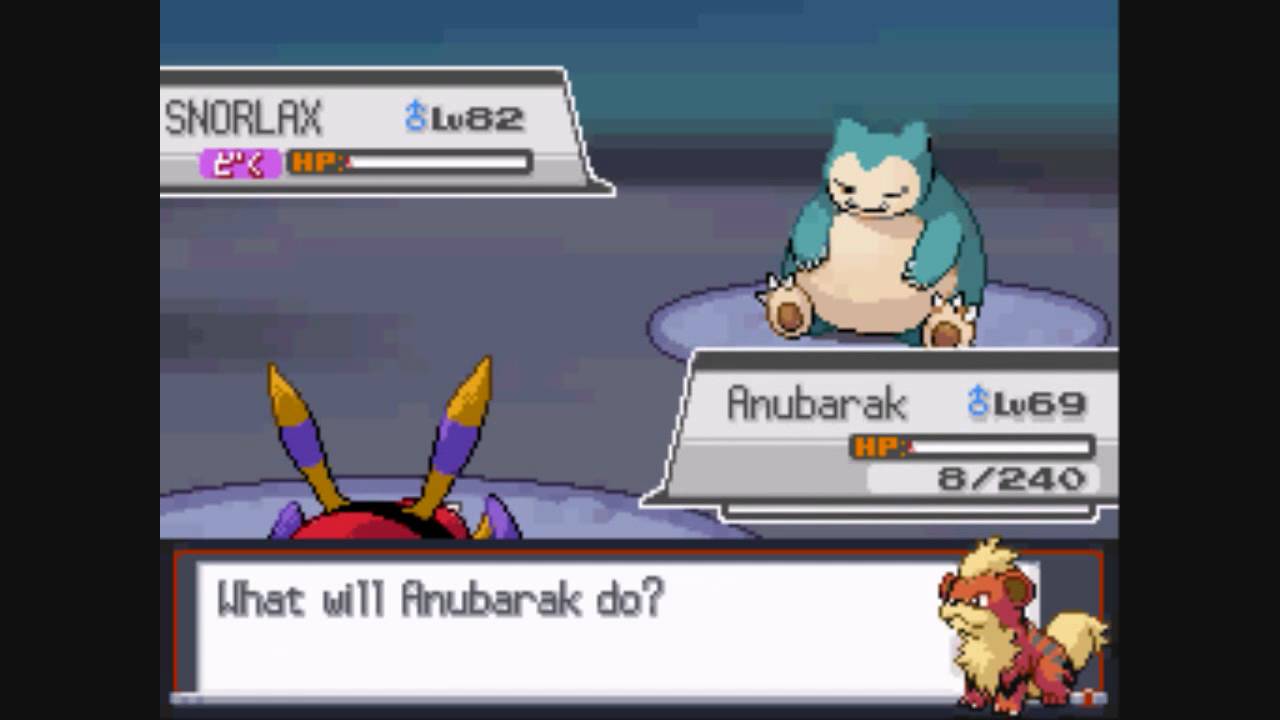
Pokemon gives information to the player via NPC interaction (reading what they have to say) and by just playing the game. You'll learn strengths and weakness by testing out if it works - "Will this water move be super effective against a dual-type Rock-Grass?"

When battling, however, you can only see how many Pokemon the opponent has and whether the Pokemon has fainted or not (this is indicated by a dimmed out Pokeball as opposed to a lit-up one). Other than that, you have to wait until the Pokemon is sent out to see it. Even after it has been sent out, there is no screen to access what Pokemon an opponent has played and what they haven't, leaving you to memorize teams on the fly as each Pokemon is introduced. You can also see the opposing Pokemon's current health (not numerically, just by a color-coded bar) and whether that Pokemon has any status afflictions. Any buffs they receive to stats must be memorized by you the player, however, all stats are lost on a Pokemon switch out.


Sequencing:

Pokemon battles are sequenced so each Player inputs their move each turn at the same time. These moves are then carried out based on two factors: Priority and Pokemon's Speed. For example, switching out a Pokemon has higher priority than a Pokemon performing a move (unless that move is Pursuit). This means you will always switch Pokemon before an opponent performs their move. Moves like Quick Attack have +2 priority. This means, regardless of a Pokemon's Speed, Quick Attack will always go before the opponent (unless they use a move with even higher priority, such as Protect, or switch out their Pokemon, which has the highest).

Player Interaction:

As stated many times throughout this blog, Pokemon has player interaction, but in a very bizarre and limited format. To optimally trade/battle with people, you need to first get their Friend Code. Once both of you have each other's Friend Code, you can then decide to meet online through the internet or something, since there is no player-to-player contact through the game itself. Additionally, you can fight random people in 3v3 battles or trade for specific Pokemon with unknown people via the Global Trade Centre (found in-game).

Theme/Setting:

The theme of HG/SS is raising your Pokemon with love and care instead of whipping them into being the strongest. This point is driven throughout the whole game and then bludgeons you over the head with it right at the end of the game.

How do these systems come together to work?

Freakin. Wonderfully. While its not all roses, Pokemon can be a very enjoyable game. Since there is so much to do, you're never really forced to perform any one task. You can breed, you can collect, you can just battle... its all up to you. On top of this, you've got over 500 Pokemon to choose from and two regions to go back and forth between. They've really catered to gamers of all levels - this can be seen in the IV and EV aspect of the game.

Individual values and Effort values are (well, used to be) a hidden aspect of the Pokemon competitive scene that most players were unaware of if they haven't ventured off into the deep, dark Internet. Essentially, these stats are what the big boys use to calculate each and every single situation - no joke.


  • Surf vs. 4/0 Breloom: 275-324 (104.96 - 123.66%) – guaranteed OHKO
  • Surf vs. 0/4 Keldeo: 197-232 (60.99 - 71.82%) – guaranteed 2HKO
  • Surf vs. 56/0 Kyurem-B: 198-234 (48.88 - 57.77%) – guaranteed 2HKO after Stealth Rock
  • Surf vs. 252/0 Politoed: 182-214 (47.39 - 55.72%) – guaranteed 2HKO after Stealth Rock
  • Surf vs. 72/0 Latias: 144-171 (45.14 - 53.6%) – guaranteed 2HKO after Stealth Rock
    (Calculations take from smogon.com for Gastrodon)


    However, you can still enjoy Pokemon whether or not you know of the existence of these things - you can still use your favourite Pokemon with your favourite moves to battle. (Mind you, you might not win ever, but you still can). Or maybe you hate battling? Maybe you just wanna play Pokemon mini-games all day? Pokemon is ok with this too, and you still get in-game rewards for winning the Pokealthon.

    Or you can just stay in the Battle Frontier and collect all the golden badges that each arena has - fighting hordes of NPCs with annoying Pokemon combos in a 3v3 fashion. Like, there is actually just SO MUCH. And it blends together perfectly, regardless of your skill level. Heck, the game lets you determine your skill level - you can delve as deep as you want to before you hit the bottom, the game won't punish you for not going as low as the next person. The only thing I would like to change is being able to see what an opponent has already sent out - it kinda sucks having to remember all 6 random Pokemon your opponent has.

    None the less, Pokemon is an amazing game that has everything a strategy nut should love.
  • Saturday, 30 November 2013

    Everybody's a critic.

    Sonic the Hedgehog 4: Episode One (because heaven forbid they release the whole game at once) is a sad, sad attempt at bringing Sonic the Hedgehog back to his "roots" in a blur of 2D side scrolling action. Instead what we got was a very bloomed Sonic with some ok levels and questionable mechanics. While it was a step in the right direction, the fact that the game is fairly short coupled with weird, feeling game-play/physics, make it just fall short of being Sonic's grand re-entry to the side scrolling scene. In this blog, we'll be looking at Sonic 4's formal elements and alayzing how, when set in motion, they leave Sonic 4 feeling lacking.

    "You're too slow."

    Sonic 4 is a single player game with multiplayer interaction via leader-boards for both scores and times. The objective of the game is to get beat 3 acts and a boss across 4 worlds while collecting the Chaos Emeralds. The procedures are as follows:

    1. Sonic can run.
    2. Sonic can jump.
    3. Sonic can dash in the air after jumping - this will also lock on to certain objects and enemies.
    4. The longer you hold left or right, the faster Sonic will go (up to a cap).
    5. At any time during your run, you can hit down to curl into a ball.
    6. From neutral, you can hold down and jump to curl into a ball. Releasing jump will send you forward.
    7. Sonic collects rings that count as his health.
    8. When Sonic gets hit by something, he drops all his rings (these can be picked up, but will disappear after a short time)
    9. If Sonic gets hit with no rings, Sonic dies.
    There's also fall pits, spike and spike traps, enemies, and different environmental obstacles based on your current world. Sonic always starts on the left and usually progresses to the right, which is where the end goal is. If Sonic has 50 or more rings and passes the goal, a warp gate to the special world will appear. If Sonic completes the special world, we will obtain a Chaos Emerald.

    The rules of Sonic are if you get hit with no rings, you lose a life. If you lose all your lives, its game over. When you complete a level, your time and ring count are calculated into a score. The rules for Sonic are as follows:
    1. If Sonic collides with an object via the lock on feature for his air dash, he can air dash again.
    2. You can affect Sonic's horizontal velocity by holding down left or right (this works in the air as well)
    3. After air dashing into an object, Sonic gains vertical velocity but loses his horizontal velocity (this can be slightly fixed by air dashing again after moving up)
    4. When Sonic gets hit by an enemy/obstacle, he loses all velocity, is pushed back from the place he was hit and is invincible for a few seconds.
    The resources in Sonic are your lives (1-UPs), rings, Chaos Emeralds, time and various power-ups that are placed throughout the levels. The conflict within Sonic is the process of getting to the end of each level while having enough rings to open the special world and collecting a Chaos Emerald. On a larger scale, you also need to defeat all the bosses and stop Eggman from killing you. (Which is the whole point of Sonic 4. But actually. Read the description.) The boundaries vary based on what zone your are in (in the Special Zone, for example, has a different gravity system and way of exiting) and the outcome of the game is really whether or not you will defeat Eggman.

    While this looks fine and dandy - heck, even like it plays like old Sonic - it really isn't as peachy as it sounds. For starters, Sonic's run speed from neutral feels really, REALLY slow in the middle. (Not to mention it looks wonky and not synced with the speed). Also, the air dash could have used more tweaking - losing all your speed for air dashing makes it nonviable. There's actually a segment in the game in which you air dash five enemies in a row with no alternative to crossing the giant gap. The first time I did this, after killing the fifth enemy, I just dropped since I figured, "Ok, killed all the enemies. Time to fall to the other end of the gap." But, instead, my reward was watching the edge pass me as a fell to my death. All because I didn't press air dash again to regain my forward momentum THAT THEY TAKE AWAY FROM YOU FOR COLLIDING WITH THE AIR DASH. Ahem. Sorry, as someone who has played Sonic Rush and has SEEN Sega do a great air dash in a 2D game, it really makes me wonder why they would do this. Maybe this Sonic was meant to be fast, but slow? As in this is merely a tool to help the player focus on where Sonic is.

    Which they should have no problem with, since the camera is glued to Sonic... almost too much. There's not a lot of give to it, which adds a speed deficit effect, if you will. Sonic should feel fast. While this game makes it look like its fast, it really is going quite slow. Which brings me to why the developers probably made all the decisions they made.

    Sega has been having a tough time with the 3D Sonic series post-Sonic Adventure 2. Sonic 4 is directly linked to Sonic 3 story wise and was Sega's response to the constant "Where's old 2D Sonic?" Effectively, they tried to modernize old Sonic. This point is further emphasized in the 4 frame Sonic wiggling his finger at you on the title screen. This modernization is what makes it look like a Sonic game but not FEEL like a Sonic game. That's why the developers left us with what feels almost like we're playing old Sonic, but not quite. As you watch him run, you can see something is wrong. As you jump, you don't feel as speedy as the Blue Blur should.


    Part of Sonic has always been the difficulty of balancing going to fast with seeing what was coming next. Removing that element by adding things like a slow air dash and a weird speed-up time ruined what we as fans of Sonic wanted from the game. Sure, the Special Zone is exactly like Sonic 1. Sure, we're back on Angel Island running through all the old levels in new HD graphics. But its not Sonic. It really is not. This whole rant has made me sad inside. I think I'm going to go play Sonic CD.

    Wednesday, 27 November 2013

    Remember the feels.

    Yes, its time. Time for more love to a game that I feel was underrated and little bit belittled for no good reason. And that game... is... issssss.... Ah yes, Remember Me. [SPOILER ALERT DOWN BELOW FOR THE REST OF THIS BLOG]


    Remember Me is chock full of emotional juiciness in both the main characters and the lives of those she (and to a lesser extent, they) touches. While it isn't quite apparent at first (since Nilin has just had her memory wiped), you start to warm up towards the main character. At first, I was all, "Man, she's a criminal or something. Maybe." But as it turns out, you're only half a criminal! As you learn about your past you start to question your future more and its just a whole roller-coaster ride of emotions. What makes you feel even worse (or better... or just feel in general) is remix the characters' memories. While there are only 4 points in which this happens (3, if we're being really technical); what you need to achieve in each remix is very interesting. For example, in the first remix, you need to edit the woman's memory so that she thinks the doctors KILLED HER HUSBAND. Oh yeah, we're getting heavy right off the bat. The cool part is that going through the memory is sort of non-linear: the timeline plays forward, but you can edit objects at certain points in time. This in turn splits the memory at each "point" that you've modified. (You can rewind backward to delete the modification as well, looking for the optimal "memory tweaks" to get the desired result).

    The whole memory remix thing is a two fold as it both sparked my imagination and provided me with copious amounts of feels. It was really neat to see how you could remix and explore various options of one person's memory (although the things I could edit were fixed, it still felt like I was manipulating their brain). On top of this, I'm the only person in the world who can do it, thanks to the glove that my father made. And why, you may ask, did my father make the glove? SO HE COULD REMIX MY MEMORY AND REMOVE THE REALLY PAINFUL ONE(S). 

    I say one because your family is broken apart due to your mother blaming you for distracting her in the car and crashing (which is actually the most illegitimate excuse). This led to your father creating the memory remixer (so you could forget the car crash) which in turn led to the memory bank thing, which in turn led to the near destruction of the city of Neo-Paris.

    On top of this, while you are regaining your memory, you REMIX YOUR OWN MOTHER'S MEMORIES. (Mind you, you don't realize its her until after the remixing). You rig her memory so she thinks she's completely responsible for the crash. While this fixes your personal life, it also makes you question your leader, Edge. He's the one that's been blindly pointing you towards your and the group you are part of, the Errorists, goals. (Since when the game starts, you have no memory of what is going on). He breaks you out of prison and your relationship with him wavers over the course of the game; y'know since he's making you remix your parents memories and stuff. The real deal breaker is at the end and as much as I want to spoil it, I think even typing this may have been too much. Just know this: the feels are EXTREMELY BOUNTIFUL AT THE END.

    Nilin as a character is also just... so easy to connect with. You feel terrible for her during the whole game and you just want to help her. (By... I dunno, being good at the game, I guess). Watching her uncover her past and seeing how memory and emotions connect... the game has a very powerful over-arcing theme in this respect. In summary, Remember Me is a game that illuminated the mind, the imagination and my emotions. It has a cool device that doubles as a weapon/boxing glove/gun/brain terrorist thing and it also has enough emotionally going on that you have waves of feels for pretty much the whole game.

    Monday, 11 November 2013

    God of Camera

    It may seem hard to believe (or maybe the change was so seamless, we never noticed it coming until it was over), but games didn't always have the robust, dynamic systems they do today. In the earlier days, all the action was contained to a single screen (oh yeah, we didn't even have scrolling). Eventually, scrolling was integrated and when we finally got to 3D games, we had the camera usually following the player. The player would have the option to rotate the camera, or zoom in and out - but the camera was (usually) ALWAYS focused on the player. This all changed, however, with a game known as God of War. God of War broke the mold for the camera; it wasn't just about the character anymore. It was the character and the environment together, creating a more artistic, almost movie-like experience. Not every game adopted this exact style after, but the system they used has become extremely popular in modern games. Instead of focal points on characters, developers place nodes throughout the level with various weights on them. As the character approaches the node, the camera interpolates according.

    Above is the result of using node traversal for the camera.

    A game that I have been playing recently that uses this technique extremely well is Remember Me. It has a third person camera similar to that of Dead Space, with this shaky vibe that persists throughout the game to add to the feelings of confusion and disorientation. There's always sweet GUI overlays everywhere and the way the text is used and interacts with the camera is phenomenal. The amount of nodes there are for each cut-scene and interspersed within the levels keeps everything looking fresh, even while platforming. It also (kind of) hints toward where you should go next, which can be beneficial when you're avoiding security drones on the fly. Below is the into sequence to the game and it perfectly sets the mood for the game and camera. The real fun starts after 2:34.


    In the first few moments of in-game cinematic, you can see just how many different nodes and triggers there are. What's nice is that even while this is going on, there are still moments where you can rotate the camera and look around while the events are happening. The first time you get to move the camera is really neat as well: instead of just slapping some text on screen, they give the movement purpose. After holding the camera to look at the robot, you get your "eyes scanned." This is a neat way at adding interactivity to the game while also setting the tale. What's also neat is the way the camera bobs as you awkwardly stumble forward. Since your "memory has been deleted," the camera even does little glitch things as you progress (keep in mind that everyone in this world has a brain computer thing, which is why you can see floating images everywhere). Later on the game, there's also a shaky-cam effect that the camera will occasionally perform, presumably some random "jitter" variable that is used.

    When you end up escaping the death of the memory wiping chair, there's this awesome sequence where the camera pulls back as you escape a robot bent on stopping you. Whenever the robot breaks something and causes you to stumble, however, the camera zooms back in on the character until she's gained her balance, then it recedes back to its old distance. This sequence gives a clearer idea on how the camera is implemented into the game. While the camera is linked to the main character, it isn't necessarily focused on her. (Note that the camera is actually very slightly to the right of the girl). When the camera rotates, we can see that it does rotate around the main character, but it always keeps her slightly to the left. This means that there is a node that follows the main character that the camera can swap to and from as necessary based on the triggers in the world. For example, in the robot sequence, when the camera pans back, it has a focus on the whole hall. When it shakes, it goes in-between the event node and the character node and does the wiggle effect based on the trigger of the main character losing her balance. At the end of the hall, you can see it actually snap back to the character.

    Such a robust camera system allows for a more cinematic gaming experience; arguably a "vastly greater and more involved one." While I won't disagree, I will say that the feel of a game should be the top priority in deciding your system of camera. In a 2D game, I don't know if I would necessarily want a node traversal system for my camera (mind you, it wouldn't be a bad idea!) since I may be able to accomplish the same effects without having to implement it. 3D is a whole 'nother can of worms which I don't want to open... today anyway. 

    So yes, Remember Me is a fantastic emotional and visually appealing game, which decent combat and some nice platforming/puzzles. I would even go as far as to argue that the camera system is what made me enjoy the game. If the camera didn't respond the way it did, or simply rotated around the character instead of interacting with the game world and leaving the character slightly off center, I may have not enjoyed the game. I'm sure these things were taken into account as the game was created, and maybe at one time the character was center. Its these little things in the camera system that we take for granted, but I won't anymore. I hope that all my camera systems are one day, just as awesome as these.