Saturday, 30 November 2013

Everybody's a critic.

Sonic the Hedgehog 4: Episode One (because heaven forbid they release the whole game at once) is a sad, sad attempt at bringing Sonic the Hedgehog back to his "roots" in a blur of 2D side scrolling action. Instead what we got was a very bloomed Sonic with some ok levels and questionable mechanics. While it was a step in the right direction, the fact that the game is fairly short coupled with weird, feeling game-play/physics, make it just fall short of being Sonic's grand re-entry to the side scrolling scene. In this blog, we'll be looking at Sonic 4's formal elements and alayzing how, when set in motion, they leave Sonic 4 feeling lacking.

"You're too slow."

Sonic 4 is a single player game with multiplayer interaction via leader-boards for both scores and times. The objective of the game is to get beat 3 acts and a boss across 4 worlds while collecting the Chaos Emeralds. The procedures are as follows:

  1. Sonic can run.
  2. Sonic can jump.
  3. Sonic can dash in the air after jumping - this will also lock on to certain objects and enemies.
  4. The longer you hold left or right, the faster Sonic will go (up to a cap).
  5. At any time during your run, you can hit down to curl into a ball.
  6. From neutral, you can hold down and jump to curl into a ball. Releasing jump will send you forward.
  7. Sonic collects rings that count as his health.
  8. When Sonic gets hit by something, he drops all his rings (these can be picked up, but will disappear after a short time)
  9. If Sonic gets hit with no rings, Sonic dies.
There's also fall pits, spike and spike traps, enemies, and different environmental obstacles based on your current world. Sonic always starts on the left and usually progresses to the right, which is where the end goal is. If Sonic has 50 or more rings and passes the goal, a warp gate to the special world will appear. If Sonic completes the special world, we will obtain a Chaos Emerald.

The rules of Sonic are if you get hit with no rings, you lose a life. If you lose all your lives, its game over. When you complete a level, your time and ring count are calculated into a score. The rules for Sonic are as follows:
  1. If Sonic collides with an object via the lock on feature for his air dash, he can air dash again.
  2. You can affect Sonic's horizontal velocity by holding down left or right (this works in the air as well)
  3. After air dashing into an object, Sonic gains vertical velocity but loses his horizontal velocity (this can be slightly fixed by air dashing again after moving up)
  4. When Sonic gets hit by an enemy/obstacle, he loses all velocity, is pushed back from the place he was hit and is invincible for a few seconds.
The resources in Sonic are your lives (1-UPs), rings, Chaos Emeralds, time and various power-ups that are placed throughout the levels. The conflict within Sonic is the process of getting to the end of each level while having enough rings to open the special world and collecting a Chaos Emerald. On a larger scale, you also need to defeat all the bosses and stop Eggman from killing you. (Which is the whole point of Sonic 4. But actually. Read the description.) The boundaries vary based on what zone your are in (in the Special Zone, for example, has a different gravity system and way of exiting) and the outcome of the game is really whether or not you will defeat Eggman.

While this looks fine and dandy - heck, even like it plays like old Sonic - it really isn't as peachy as it sounds. For starters, Sonic's run speed from neutral feels really, REALLY slow in the middle. (Not to mention it looks wonky and not synced with the speed). Also, the air dash could have used more tweaking - losing all your speed for air dashing makes it nonviable. There's actually a segment in the game in which you air dash five enemies in a row with no alternative to crossing the giant gap. The first time I did this, after killing the fifth enemy, I just dropped since I figured, "Ok, killed all the enemies. Time to fall to the other end of the gap." But, instead, my reward was watching the edge pass me as a fell to my death. All because I didn't press air dash again to regain my forward momentum THAT THEY TAKE AWAY FROM YOU FOR COLLIDING WITH THE AIR DASH. Ahem. Sorry, as someone who has played Sonic Rush and has SEEN Sega do a great air dash in a 2D game, it really makes me wonder why they would do this. Maybe this Sonic was meant to be fast, but slow? As in this is merely a tool to help the player focus on where Sonic is.

Which they should have no problem with, since the camera is glued to Sonic... almost too much. There's not a lot of give to it, which adds a speed deficit effect, if you will. Sonic should feel fast. While this game makes it look like its fast, it really is going quite slow. Which brings me to why the developers probably made all the decisions they made.

Sega has been having a tough time with the 3D Sonic series post-Sonic Adventure 2. Sonic 4 is directly linked to Sonic 3 story wise and was Sega's response to the constant "Where's old 2D Sonic?" Effectively, they tried to modernize old Sonic. This point is further emphasized in the 4 frame Sonic wiggling his finger at you on the title screen. This modernization is what makes it look like a Sonic game but not FEEL like a Sonic game. That's why the developers left us with what feels almost like we're playing old Sonic, but not quite. As you watch him run, you can see something is wrong. As you jump, you don't feel as speedy as the Blue Blur should.


Part of Sonic has always been the difficulty of balancing going to fast with seeing what was coming next. Removing that element by adding things like a slow air dash and a weird speed-up time ruined what we as fans of Sonic wanted from the game. Sure, the Special Zone is exactly like Sonic 1. Sure, we're back on Angel Island running through all the old levels in new HD graphics. But its not Sonic. It really is not. This whole rant has made me sad inside. I think I'm going to go play Sonic CD.

Wednesday, 27 November 2013

Remember the feels.

Yes, its time. Time for more love to a game that I feel was underrated and little bit belittled for no good reason. And that game... is... issssss.... Ah yes, Remember Me. [SPOILER ALERT DOWN BELOW FOR THE REST OF THIS BLOG]


Remember Me is chock full of emotional juiciness in both the main characters and the lives of those she (and to a lesser extent, they) touches. While it isn't quite apparent at first (since Nilin has just had her memory wiped), you start to warm up towards the main character. At first, I was all, "Man, she's a criminal or something. Maybe." But as it turns out, you're only half a criminal! As you learn about your past you start to question your future more and its just a whole roller-coaster ride of emotions. What makes you feel even worse (or better... or just feel in general) is remix the characters' memories. While there are only 4 points in which this happens (3, if we're being really technical); what you need to achieve in each remix is very interesting. For example, in the first remix, you need to edit the woman's memory so that she thinks the doctors KILLED HER HUSBAND. Oh yeah, we're getting heavy right off the bat. The cool part is that going through the memory is sort of non-linear: the timeline plays forward, but you can edit objects at certain points in time. This in turn splits the memory at each "point" that you've modified. (You can rewind backward to delete the modification as well, looking for the optimal "memory tweaks" to get the desired result).

The whole memory remix thing is a two fold as it both sparked my imagination and provided me with copious amounts of feels. It was really neat to see how you could remix and explore various options of one person's memory (although the things I could edit were fixed, it still felt like I was manipulating their brain). On top of this, I'm the only person in the world who can do it, thanks to the glove that my father made. And why, you may ask, did my father make the glove? SO HE COULD REMIX MY MEMORY AND REMOVE THE REALLY PAINFUL ONE(S). 

I say one because your family is broken apart due to your mother blaming you for distracting her in the car and crashing (which is actually the most illegitimate excuse). This led to your father creating the memory remixer (so you could forget the car crash) which in turn led to the memory bank thing, which in turn led to the near destruction of the city of Neo-Paris.

On top of this, while you are regaining your memory, you REMIX YOUR OWN MOTHER'S MEMORIES. (Mind you, you don't realize its her until after the remixing). You rig her memory so she thinks she's completely responsible for the crash. While this fixes your personal life, it also makes you question your leader, Edge. He's the one that's been blindly pointing you towards your and the group you are part of, the Errorists, goals. (Since when the game starts, you have no memory of what is going on). He breaks you out of prison and your relationship with him wavers over the course of the game; y'know since he's making you remix your parents memories and stuff. The real deal breaker is at the end and as much as I want to spoil it, I think even typing this may have been too much. Just know this: the feels are EXTREMELY BOUNTIFUL AT THE END.

Nilin as a character is also just... so easy to connect with. You feel terrible for her during the whole game and you just want to help her. (By... I dunno, being good at the game, I guess). Watching her uncover her past and seeing how memory and emotions connect... the game has a very powerful over-arcing theme in this respect. In summary, Remember Me is a game that illuminated the mind, the imagination and my emotions. It has a cool device that doubles as a weapon/boxing glove/gun/brain terrorist thing and it also has enough emotionally going on that you have waves of feels for pretty much the whole game.

Monday, 11 November 2013

God of Camera

It may seem hard to believe (or maybe the change was so seamless, we never noticed it coming until it was over), but games didn't always have the robust, dynamic systems they do today. In the earlier days, all the action was contained to a single screen (oh yeah, we didn't even have scrolling). Eventually, scrolling was integrated and when we finally got to 3D games, we had the camera usually following the player. The player would have the option to rotate the camera, or zoom in and out - but the camera was (usually) ALWAYS focused on the player. This all changed, however, with a game known as God of War. God of War broke the mold for the camera; it wasn't just about the character anymore. It was the character and the environment together, creating a more artistic, almost movie-like experience. Not every game adopted this exact style after, but the system they used has become extremely popular in modern games. Instead of focal points on characters, developers place nodes throughout the level with various weights on them. As the character approaches the node, the camera interpolates according.

Above is the result of using node traversal for the camera.

A game that I have been playing recently that uses this technique extremely well is Remember Me. It has a third person camera similar to that of Dead Space, with this shaky vibe that persists throughout the game to add to the feelings of confusion and disorientation. There's always sweet GUI overlays everywhere and the way the text is used and interacts with the camera is phenomenal. The amount of nodes there are for each cut-scene and interspersed within the levels keeps everything looking fresh, even while platforming. It also (kind of) hints toward where you should go next, which can be beneficial when you're avoiding security drones on the fly. Below is the into sequence to the game and it perfectly sets the mood for the game and camera. The real fun starts after 2:34.


In the first few moments of in-game cinematic, you can see just how many different nodes and triggers there are. What's nice is that even while this is going on, there are still moments where you can rotate the camera and look around while the events are happening. The first time you get to move the camera is really neat as well: instead of just slapping some text on screen, they give the movement purpose. After holding the camera to look at the robot, you get your "eyes scanned." This is a neat way at adding interactivity to the game while also setting the tale. What's also neat is the way the camera bobs as you awkwardly stumble forward. Since your "memory has been deleted," the camera even does little glitch things as you progress (keep in mind that everyone in this world has a brain computer thing, which is why you can see floating images everywhere). Later on the game, there's also a shaky-cam effect that the camera will occasionally perform, presumably some random "jitter" variable that is used.

When you end up escaping the death of the memory wiping chair, there's this awesome sequence where the camera pulls back as you escape a robot bent on stopping you. Whenever the robot breaks something and causes you to stumble, however, the camera zooms back in on the character until she's gained her balance, then it recedes back to its old distance. This sequence gives a clearer idea on how the camera is implemented into the game. While the camera is linked to the main character, it isn't necessarily focused on her. (Note that the camera is actually very slightly to the right of the girl). When the camera rotates, we can see that it does rotate around the main character, but it always keeps her slightly to the left. This means that there is a node that follows the main character that the camera can swap to and from as necessary based on the triggers in the world. For example, in the robot sequence, when the camera pans back, it has a focus on the whole hall. When it shakes, it goes in-between the event node and the character node and does the wiggle effect based on the trigger of the main character losing her balance. At the end of the hall, you can see it actually snap back to the character.

Such a robust camera system allows for a more cinematic gaming experience; arguably a "vastly greater and more involved one." While I won't disagree, I will say that the feel of a game should be the top priority in deciding your system of camera. In a 2D game, I don't know if I would necessarily want a node traversal system for my camera (mind you, it wouldn't be a bad idea!) since I may be able to accomplish the same effects without having to implement it. 3D is a whole 'nother can of worms which I don't want to open... today anyway. 

So yes, Remember Me is a fantastic emotional and visually appealing game, which decent combat and some nice platforming/puzzles. I would even go as far as to argue that the camera system is what made me enjoy the game. If the camera didn't respond the way it did, or simply rotated around the character instead of interacting with the game world and leaving the character slightly off center, I may have not enjoyed the game. I'm sure these things were taken into account as the game was created, and maybe at one time the character was center. Its these little things in the camera system that we take for granted, but I won't anymore. I hope that all my camera systems are one day, just as awesome as these.

Wednesday, 16 October 2013

OBJECTION!!!

Now, coming to you live from your computer screen, this is:

DUR BURST GURMS ERRRVURRRRR <3
(The Best Games Ever)

1. Pokemon: Travel the world collecting Pokemon and filling your Pokedex while aiming to be the number one Trainer.

2. Final Fantasy: As a party of four, you venture forth to restore light to the world and its Crystals while ridding it of the uprising darkness.

3. Tony Hawk's Underground: Skate your way to fame as you tour the world hitting the sweetest spots known to man.

4. Torchlight II: Stop the rise of the Alchemist as you progress through various dungeons to get better equipment, higher levels and thus, access to more spells.

5. Shadow of the Colossus: Travel across a forsaken land, defeating giant monoliths in an attempt to revive a young girl.

6. Super Mario Wii U: Use various power ups while thwarting Bowser and his minions across 8 worlds in an attempt to save Princess Peach.

7. Peggle Nights: Compete for top scores in over 100 different levels as you try to become the Peggle Master in your own right: be it through collecting all the Ribbons or holding the highest score.

8. Advance War: Stop the evil Blue Ribbon Army from taking over the land as you fight in turn based tactical combat.

9. Mario Tennis: Compete in tournaments or play in mini-games, follow the rules of tennis with a Mario twist! (They have superpowers!!)

10. Picross DS: Solve puzzles as you try to complete all the levels in this challenging mind game.

Note: These aren't my only favourite games, just a few of the many, many titles I love.

So what's with the list? Well, essentially I'm trying to see if there are any similarities in the objectives of the games that I enjoy and from this try to see what types of games appeal to me. This is an interesting challenge in the sense that I've always believed I loved games based on uniqueness and style - but its time to find out. Right off the bat, I can see that a lot of these games involve exploration; each game has its own unique world in which the events take place, and most times you are travelling across this world. Out of the 10 listed, at least 7 posses this quality. This actually links with my proposed belief in the style of games - I think I enjoy travelling across these worlds and seeing all of what each one has to offer. When I play games, I spend a big portion of my play time simply walking through the worlds: in Final Fantasy, I like seeing the different enemies I can encounter, in Super Mario Wii U, I loved seeing the themes of each world and the puzzles that each world presented.

That's another similarity for sure - puzzles. I loveeeee puzzle games, and that can be seen between each game to at least some degree. Its heavily prevalent in titles like Picross DS and Advance War, but it also exists in games like Torchlight II. Simply deciding your class in this game can be a mission, since each class has three overall skill trees it can then pick from. This creates a vast amount of customization and options for each character, as certain skills match up with certain gear, etc. To simply, maybe I enjoy games that require constant thinking and interaction - in Mario Tennis, there's a whole mind game to the Super Shots. At its core, once the shots are acquired, it comes down to the first person to miss the ball and use their save shot (a skill which grabs the ball from anywhere but makes for a weak shot). If the game looks good and my brain is working while I'm playing, then I'm happy.

So, when it comes to what games do I like, I think its safe to stick with two things: it needs to be original/feel original, have a good style and I need to use my brain. However, I don't think I need all three categories - I enjoy God of War, which can feel brainless at times. Its sprinkled with puzzles throughout and the style is awesome. Its also an original take on the hack and slash genre and the quick time events aren't guaranteed, meaning you need to pay attention to what comes up on the screen. Witty writing is a plus and lord knows if the music is bumpin' I'm more inclined to be a fan.

Which is why this game (and series) is probably one of my all time favourites.

Tuesday, 15 October 2013

Gotta go fast; gotta go faster.

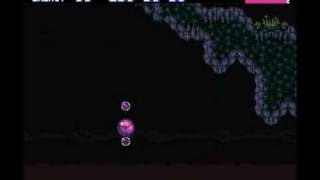
My previous post had mentioned how items are pivotal to game play within certain games and how the acquisition of items changes game-play to varying degrees. What I didn't stress as heavily is how acquiring certain items can drastically change a players approach to the game. In Super Mario World, when you get a cape, do you continue to just run on the ground? No - you jump and fly and use the capes power. Although this is usually intended for the game, there are certain exploits that develop from certain items. For example, in Metriod Prime, there are two items that can allow the player to skip large sections of the game, including certain items, bosses, areas, etc. These would be the Bomb and the Space Jump. Space Jump allows the player to perform a double jump. The Bomb power up allows Samus to drop bombs when in Morph Ball mode. While it is an element of the game that is worked into game-play (e.g. you need to perform this trick to progress to certain areas/acquire certain items ) this also led to things like being able to infinitely bounce. The two powers together are equally as deadly, leading to more useful tricks. The item I designed this time around is focused on creating to quickly traverse the map while also requiring skill and focus to utilize.

As you can see, this trick has been around for a long time.
Above image taken from http://i1.ytimg.com/vi/vb8eTUKVvD8/mqdefault.jpg


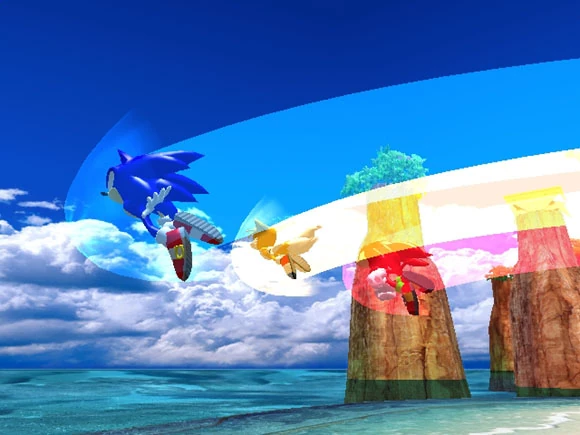
We'll be looking at the game Sonic Adventure 2 - one of my favourite Gamecube games. It already has the element of speed in it since Sonic and the gang run pretty fast, but getting to top speed can be a chore at times. The item would be used on Sonic/Shadow and would also be a sort of attack combo upgrade. It would be called the Cammy Boots and would be an additional add-on for their sneakers. Acquiring the item would allow the player to perform a dive kick move (when in the air) that could be chained into a forward dash. That dash momentum could then be used in a jump, which allows for the player to repeat the process - making for a speedy way of traversing levels. However, the whole goal of playing as Sonic/Shadow in Sonic Adventure is to see how fast you can beat a level - this means the item would need a really tight frame window in which the player is allowed to execute the movement. The whole combination should feel rewarding; each dash should be earned. At an extremely technical level, lets say that Sonic/Shadow jumps with A, presses down and A+B to dash downward, has to press L RIGHT before hitting the ground and the press forward and B to dash forward (let's say there would also be a sort of aura that surrounds Sonic/Shadow, similar to the Air Dash).

Like this.
Above image taken from http://images1.wikia.nocookie.net/__cb20120226010635/sonic/images/4/47/Shjumpdash.jpg


Right as the aura ends, there should be a slight burst that signals its time to press A to jump again and get the most from the dash. This would then be repeated as needed. I absolutely love the ability to increase my speed through timed button inputs - and this love was initially sparked by Super Mario 64. Within that game, you could chain long jumps together in order to max out your speed. (Although you start with the ability to perform long jumps; you don't need to unlock them). Ever since then, I've looked for similar techniques in other games - in Ocarina of Time, I found that using the side dash over and over when Z-Locked is faster than rolling forward. I would use this technique to cross Hyrule Field at fast speeds during the Young Link sections. I think bringing a speed technique to a Sonic game (which is already all about speed) would be really cool - although this is the closest thing we'll probably get.

Tuesday, 8 October 2013

It's dangerous to go alone, take this?

The Legend of Zelda series loves the whole "get item, progress in game" deal. Its a formula that has been prominent ever since its original title - although it might not be as poignant as it is in later ones. (They mostly followed a "get the item, use it immediately in the dungeon to progress, remember you have it, cause you'll need it later"). The acquisition of these items, in turn, can change play styles as well as open new areas that couldn't be previously accessed. For example, in Majora's Mask, once the player acquire's the Goron Mask, walking pretty much becomes obsolete. The roll is way faster and doesn't cost magic, giving it favor for traversing across the land.

Weeeeeeeee.

But wouldn't it be great if you could put your own item in the game? I know it would. If I could mod LoZ, I would. (Mind you, you CAN, but its a long and laborious process of love that I don't quite have time for...) Since we were talking about Majora's Mask, let's design a new item for the game. (Fun fact: second choice was A Link to the Past). With Majora's Mask being about, well, masks, I would probably add an item to the game called the Doppleganger Mask. I shant bore you with details of what it would look like, but I will say what it would bring to the table in terms of game play and how it would change the dynamic of Majora's Mask.

Like this, but picture Link.

With so many masks in Majora's, I don't think the dynamic of the game would be thrown off at all. If anything, it would add more puzzles and annoying Heart Pieces to collect. The mask would work like this - once worn, a second Link would appear next to the original link. At the same time, there's a magical "barrier" that goes between the two and runs parallel. As the player moves, the second link copies the motions in a mirrored fashion, e.g. if Link walks forward, so does 2nd Link. If Link moves to the right, 2nd Link moves to the left, etc. However, if Link crosses over past the "barrier," then the 2nd Link vanishes. Additionally, by pressing A while wearing the mask, Link can switch positions with his Doppelganger. The Doppelganger also copies any items used (if Link shoots an arrow, 2nd Link will shoot one in the same direction from wherever he is standing). Both are affected by collision as well, e.g. if 2nd Link can't move in the specified direction due to a building, crate, etc., neither can Link and vice versa.

With something this expansive, it would most likely be restricted in open areas like Great Bay, and the field surrounding the main. Where it could find its niche is in dungeons or those cool holes in the ground you find by blowing up rocks. Here are just a few examples of what could be accomplished:
  1. Let's say that there is a path ahead that branches and reconvenes at intervals. (One path splits to two paths, then those two have different paths, but come back together, etc.) Most paths at one point have a gap. You notice that where there is no gap on one side, there is on the other. What do you do? Bust out your sweet Doppleganger Mask, of course! Since both Links are linked (badoom, chhhhh), the Link with the path will allow the other Link to walk over the pathless part. You could then switch as necessary until you have traversed the path.
  2. There's a bunch of enemies in the room. Solution? Use the Mask - two Links are better than one! (Although you would take the damage from both Links... so be careful, I guess).
  3. There are two of those Eyeball switches at the end of a room. Shooting one and then the other has proved useless as the first one shot opens before the second one can be shot. What to do... Oh right, use your DOPPELGANGER MASK. (I'm enjoying that). Since both Links will shoot, all you need to do is stand in front of it and fire away.
These are just a few examples of how this mask could work. Since the game is all about masks, I feel it could be added without detracting from the rest of the game play, as well as offering unique was to combat certain situations.

Monday, 7 October 2013

Man, right in the feels.

Kingdom Hearts - I know I've talked about it before, but I just can't get enough. This series has everything I love: nice visuals/art style, solid game-play and a STORY. (Hoo mama, I love the story). While we're on the topic, I'm gonna throw down an obligatory spoiler alert as I'm about to go into some of the finer details of the series. (Although if you haven't played this game by now, you should rethink your RPG choices). The charm, the level of detail, the way they evolved the game-play over time... everything is just too good. Now, I'm not completely blind to the downfalls of the series - some of the titles should never have been released and some pivotal game-play choices within certain titles were... questionable. Never the less, the story boggled my mind and made me wish I had a Keyblade every single day.

Maybe one day I'll finally buy one off eBay...
Above image from http://th04.deviantart.net/fs36/PRE/i/2008/254/c/e/Kingdom_Key_Keyblade_by_The_Celestial_Dragon.jpg

So here's a brief run down of the first title, Kingdom Hearts. Kingdom Hearts gets released, people everywhere cry tears of joy. There's Sora - a little kid that chills on an island with his two friends, Kairi and Riku. Kairi washed up outta no where on their island one day, and ever since, the three of them have vowed they would visit other worlds and find Kairi's home. The day their about to leave, though, some evil looking dark creatures called Heartless show up. Sora goes to this secret cave where a mysterious robed man shows up. He gives some speech about the door and it is revealed that Kairi is there as well.  She says Sora's name before the door opens and projects a wave of darkness that sends Kairi through Sora (THIS IS IMPORTANT) and both of them flying out of the cave. When Sora comes to, ends up being able to wield this magic key thing (the Keyblade) and fights a big ole Heartless. He defeats it and Riku shows up, interested in where the darkness leads. Sora is also consumed by the darkness and gets sent across the universe to Traverse Town, the place where all people who survive their world getting consumed by darkness end up.

There, Sora also Leon (from Final Fantasy) and learns that the king of his world was studying the Heartless. His name, was Ansem. He also meets his boys Donald and Goofy. Their King (King Mickey) sent them to find a "key" and stick with it.  The three team up to find both Sora's friends and the King. As they travel from world to world looking for answers and locking the Keyholes of each world (pathways the Heartless use to steal hearts), they notice there are a bunch of Disney villains who have formed an alliance to capture the "Princesses of Heart" (essentially the Disney Princesses) so they can open the Keyhole to Kingdom Hearts. On top of this, Riku joined them due to Maleficent building distrust in him while promising to help him find Kairi. Riku eventually locates a comatose looking Kairi on his own.

Sora and the gang end up in Hollow Bastion - the setting of the final showdown, the home-world of Ansem and Maleficent's HQ. Upon arrival, Riku scoops the Keyblade from Sora, claiming that it was his all along and Sora was "just the delivery boy." Since Donald and Goofy have to follow the key, they begrudgingly leave Sora to follow the crazy, angsty Riku. Unwavered, Sora follows and challenges Riku to a fight, giving a big speech about how his heart gets strength from his friends. The Keyblade magically warps from Riku back to Sora and Goofy and Donald follow suit (since they gotta follow the key and all). Riku gets butt-hurt and runs off into the depths of the castle, where a hooded man tells him to give in to the darkness.

Sora and the gang have at this point defeated Maleficent. Riku comes back looking super evil and holding a new Keyblade that unlocks hearts (whatever that means). He leads them to Kairi's body, which as it turns out is missing its heart. (She's alive, but can't feel anything. She's an empty shell). Riku then reveals that he's actually Ansem possessing Riku's bod. He also reveals that Kairi is a Princess of Heart and that her heart has been hidden within Sora ever since he destroyed their island home. (Remember the whole passing through Sora thing?!?!) He also ALSO reveals that the Keyhole to this world can't be opened while the final Princess of Heart sleeps. Sora does't give a crap and beats Ansem. But something is amiss... he can't seal the Keyhole. How oh how can he do it? Looking at the Keyblade that unlocks hearts, Sora stabs him self in the, well, heart. This sends both his and Kairi's heart out of his body. Kairi wakes up with her newly recovered heart, while Sora turns into a Heartless. Sora follows the "voice of Kairi's heart" and finds his group again. Kairi returns Sora to human form. They then decide its time to end Ansem's plan.

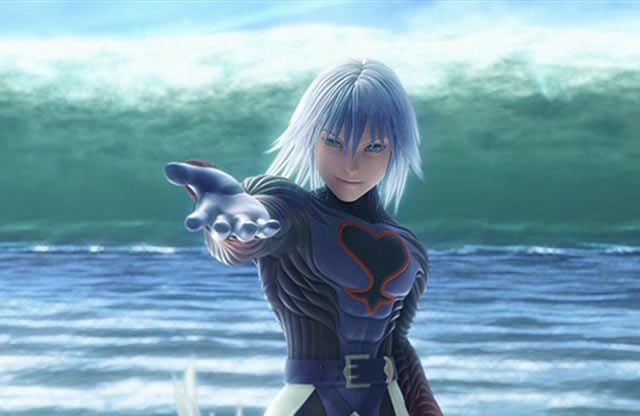
Whew. Apologies for the huge essay, but this just goes to show how detailed the story is. I'm sure while reading this, there will still be fragments that don't quite makes sense; and this is about as diluted as I could make the story. (I didn't even put in how the game ends). Now let's take a look at why this story is so amazing, why it's definitely influenced the way I write and how it elicits feelings. Right off the bat, there's three best friends. In a matter of MINUTES, these guys are split up and sent across the universe. You really see how much fun they have and how great life is on the island - it really, really hurts to watch Riku sinking into the darkness with his hand outstretched for Sora, asking him to join, while Sora reaches and reaches; unable to clasp his comprades hand. This whole juxtaposition, this come with me, this almost taunting way of saying "come find me," is a really big theme through a lot of the game.

No, seriously. The number of times this image shows up in cutscenes and such is staggering.

On top of this, there's a whole overriding theme of friendship and never being apart from people even when you are, since you are connected through your hearts. This is shown whenever Kairi/Riku is mentioned to Sora and when Sora meets new friends as he travels from world to world. The message behind the came just generates good feels all around. I know for a fact that I cried when Kairi came back to life and at the very end of the game when (SEMI-SPOILER ALERT) all of Sora's hard work is for naught. The friends we worked so hard to see just get split back apart. (SPOILER OVER).

Even Riku has it rough - being badgered by Maleficent into thinking that Sora ditched him and Kairi for Donald and Goofy. (I swear that initial trip through darkness did something to him). While we're on the subject of Riku, he is really a pivotal point in showing just how crazy the writing in this game series is. Let's look specifically at the line I chose to include, "you were just the delivery boy." Within the context of the first game, this line actually makes no sense. Why would Riku believe he is the one who is supposed to wield the Keyblade? Maleficent hasn't said it was his, Ansem hasn't said it was his... so who did? 8 years later, we got our answer.

KH: Birth by Sleep was a PSP game released in 2010. It details events that take place years before the initial Kingdom Hearts and reveals a heck of a lot about these three's past. Turns out that a Keyblade master before Riku (Terra), could see the potential in young Riku and deems him worth of being able to wield a Keyblade, feeling that "one day, he will need to protect his friends." He then let's Riku place his hand on his Keyblade. (That's like, the prerequisite to being allowed to wield one). Aqua (one of the other main characters from BBS) senses a strong tie between the young Sora and Terra and Ventus (the other other main character from BBS) but DOESN'T LET HIM TOUCH HER KEYBLADE AND MAKES NO STATEMENTS ABOUT HIM BEING ABLE TO WIELD ONE. 

Sora was never deemed worthy of a Keyblade - Riku was. Sora only got to wield one since, at the end of BBS, Ventus is put into a deep sleep. His wandering heart ends up merging with Sora's, a la same fashion as the whole Kairi-Sora heart thing, confirming the tie Aqua predicted. Since Ventus' could wield a Keyblade, Sora now can since he has Ventus' heart. If you look at Ventus' character design, he looks JUST like Roxas (Sora's Nobody). Roxas was revealed in Kingdom Hearts II - once again, before we, the player, had any knowledge of BBS. This shows even MORE of just how well thought out this whole story is. Again, I apologize for throwing names that mean nothing to you, but I actually can't even explain small parts without expanding into the larger scope.

Ventus (left) & Roxas (right)

  
Looking at this from the perspective of the player, we don't get this information until we're 8 years deep in this series. Heck, when BBS was getting screen shots EVERYONE thought that Ventus was Roxas. People used to think that Kingdom Hearts was "dragging on" as they kept adding titles to "build on the story." Well, I say HA to those people. HA to your stupid beliefs. You don't put a line like, "you're the delivery boy" in for the sake of putting it in. Every element of this game has been planned from day one - since its release in 2002. There are several other ties in that we don't learn (like Kairi being from a certain homeworld -wink wink, nudge nudge-) or just what/who Roxas is until later on in the series... even the hooded man from the beginning of the game is given context as the series progresses.

To wrap this up, all I can say is I really hope you, the reader, are craving to understand the gaps my re-iteration has left. Kingdom Hearts is a beautiful series and game; and with the release of the Kingdom Hearts HD remake (for the PS3), you now have no reason to not play it.

But seriously, this is in the intro to KH2.